



If you run an ecommerce store, abandoned carts are probably your single biggest source of “almost” revenue. A shopper browses, adds an item to their cart, gets all the way to checkout — and then disappears. No purchase, no sale, no explanation.
This happens far more often than most store owners realize. According to industry benchmarks, the average shopping cart abandonment rate sits around 70%, meaning roughly seven out of every ten shoppers who add something to their cart leave without completing the purchase. Across ecommerce as a whole, this represents hundreds of billions of dollars in recoverable revenue every year.
| The good news: abandoned cart emails are one of the most effective tools in your email marketing strategy for recovering that lost revenue. A well-built abandoned cart email sequence can recover roughly 5-15% of abandoned carts, and these automated emails consistently achieve some of the highest open rates of any email campaign type — often over 40-50%. |
In this guide, we’ll break down exactly what makes an effective abandoned cart email, walk through 10 real abandoned cart email examples from top brands, and give you templates, subject lines, and a full cart abandonment email sequence you can set up today — whether you’re on Shopify, Klaviyo, or any other email marketing platform.
Cart Abandonment by the Numbers (2026)
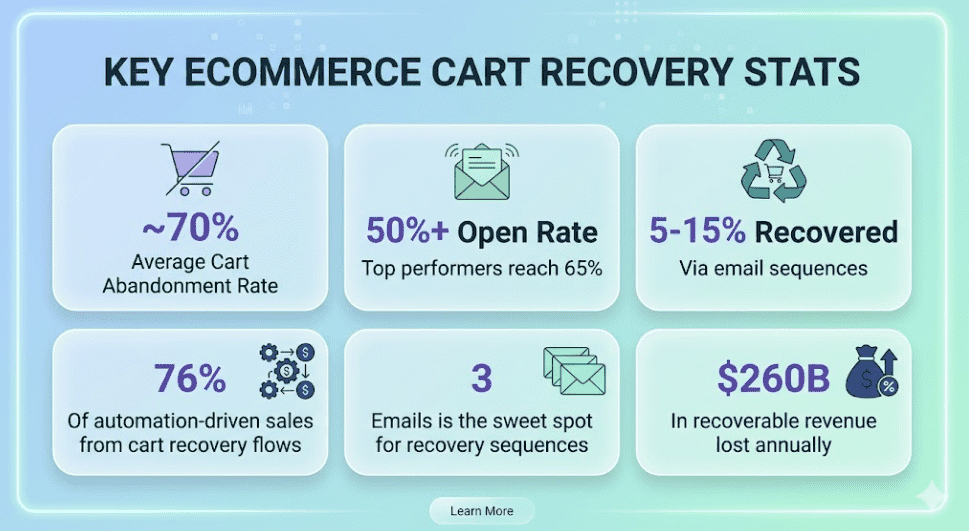
These numbers make one thing clear: if you’re not sending abandoned cart emails — or if your current cart abandonment email isn’t optimized — you’re leaving real money on the table.
What Is an Abandoned Cart Email?
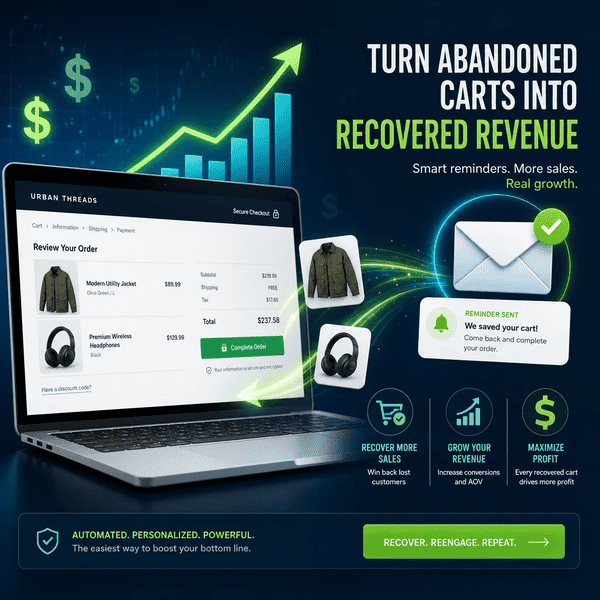
An abandoned cart email (also called a cart abandonment email or cart reminder email) is an automated email sent to customers who added items to their shopping cart but left the site before completing checkout. The goal is simple: re-engage the shopper, remind them what they left behind, and encourage them to complete their purchase.
Because these emails use first-party data — behavioral data collected with the shopper’s consent when they browse your store or sign up for your mailing list — abandoned cart emails are fully compliant with data privacy regulations. This isn’t cold outreach; it’s a timely, relevant message to someone who already showed real purchase intent.
Why Shoppers Abandon Carts in the First Place
Before building your abandoned cart email strategy, it helps to understand the common causes of cart abandonment:
• Unexpected costs at checkout (shipping, taxes, or fees)
• Being required to create an account before purchasing
• A slow, confusing, or multi-step checkout process
• Simply browsing or comparison shopping with no immediate intent to buy
• Lack of trust signals (no reviews, unclear return policy, etc.)
• Getting distracted — a phone call, a notification, a closed tab
• Price shock or wanting to wait for a discount or sale
Understanding why someone abandoned their cart helps you craft a recovery email that actually addresses their hesitation — whether that’s reassurance about shipping costs, a nudge about limited stock, or simply a friendly reminder.
Abandoned Cart Email Best Practices for 2026
Here are the core best practices that separate a high-converting abandoned cart email from one that gets ignored or unsubscribed from.
1. Send the First Email Within 1-2 Hours
Timing is everything. The first email in your abandoned cart email sequence should go out within one to two hours of abandonment — while the shopper still remembers what they were looking at and their intent is still warm. This first email should be a helpful nudge, not a hard sell: assume they got distracted or hit a technical issue, and simply remind them their cart is waiting.
2. Use an Attention-Grabbing Subject Line
Your subject line determines whether your abandoned cart email gets opened at all. The best abandoned cart email subject lines are short, personal, and create curiosity or urgency without sounding spammy. Effective formulas include:
• “You left something behind…”
• “Your cart is waiting for you”
• “Still thinking it over? Here’s 10% off”
• “[Item name] is still in your cart”
• “Don’t miss out — your cart expires soon”
• “Forgot something? Your bag is ready when you are”
3. Show the Exact Item(s) Left in the Cart
Always include a clear product image, name, and price of the items left in the cart. This visual reminder is one of the strongest conversion drivers in any abandoned cart email — it triggers recall and makes the path back to purchase frictionless.
4. Lead with a Single, Dominant Call to Action
Every recovery email should have one clear, prominent call to action — typically a “Return to Cart” or “Complete Your Purchase” button. Avoid cluttering the email with multiple competing links or offers; a single CTA performs best.
5. Build a Multi-Email Sequence (Not Just One Email)
Sending just one cart abandonment email leaves money on the table, but sending five will annoy subscribers. Industry data consistently points to a 3-email sequence as the sweet spot for recovering the most revenue:
• Email 1 (1-2 hours later): A friendly reminder — no discount yet, just “did you forget something?”
• Email 2 (24 hours later): Add urgency or social proof — mention limited stock, reviews, or a gentle nudge
• Email 3 (48-72 hours later): Introduce an incentive — a discount, free shipping, or a deadline to create urgency
6. Save the Discount for Later in the Sequence
Don’t lead with a discount in your first email — it trains customers to always wait for one, and it eats into your margins unnecessarily. Reserve discount or free shipping offers for email two or three, when the shopper still hasn’t converted and a stronger incentive is justified.
7. Create a Genuine Sense of Urgency
Phrases like “only 2 left in stock,””your cart will expire in 24 hours,” or “this offer ends tonight” tap into loss aversion and can meaningfully boost conversions — but only use urgency tactics that are true. False scarcity damages trust and brand reputation long-term.
8. Address Common Objections Directly
If shipping costs are a common reason for abandonment in your store, address it head-on: “Free shipping on orders over $50” or “Free returns within 30 days.” Removing friction at the point of hesitation is often more effective than a discount.
9. Optimize for Mobile and Email Deliverability
Most abandoned cart emails are opened on mobile devices, so your email design needs to be mobile-responsive with large, tappable CTA buttons and minimal scrolling. Equally important is deliverability — emails that land in the Promotions tab instead of the Primary inbox see dramatically lower performance, so use a verified sending domain, clean lists, and avoid spammy trigger words.
10. Personalize Beyond the Product
Use the shopper’s first name, reference their browsing behavior, and where possible recommend complementary products. Personalized abandoned cart emails consistently outperform generic templates.
11. Test and Iterate Continuously
Treat your abandoned cart email campaign as a living system, not a set-and-forget automation. A/B test subject lines, send times, discount thresholds, and email copy. Small improvements in open rate or click-through rate compound into significant recovered revenue over time.
12. Make the Return-to-Cart Path Frictionless
When a shopper clicks through from your email, they should land directly back in their cart — fully populated, with one click to checkout. Any extra steps (re-logging in, re-adding items) will kill your recovery rate.
10 Best Abandoned Cart Email Examples
Below are 10 abandoned cart email examples that demonstrate different strategies — from minimalist reminders to discount-driven urgency to brand storytelling. Use these as inspiration for your own abandoned cart email templates.
EXAMPLE 1
The Friendly Reminder (No Discount)
| Subject line: Did you forget something? Send timing: Sent 1-2 hours after abandonment Email body / structure: A clean, simple layout with the product image, name, and price of the item left in the cart, a short line of copy (“We saved your cart — pick up right where you left off”), and a single “Return to Cart” button. No discount, no urgency — just a helpful nudge. |
Why it works: This first-touch email works because it doesn’t feel like a sales pitch. It assumes good intent (the shopper got busy) and simply makes it easy to come back. Skipping the discount here also protects margins and avoids training customers to expect deals immediately.
EXAMPLE 2
The Social Proof Email
| Subject line: Still thinking about [Product Name]? Send timing: Sent 24 hours after abandonment Email body / structure: Features the abandoned product alongside a customer review or star rating (“Loved by 2,400+ customers”), a short testimonial snippet, and a “Complete Your Purchase” CTA. May include a small trust badge such as free returns or secure checkout. |
Why it works: Social proof reduces hesitation by showing the shopper that other people bought and loved the same item. This addresses trust-based objections without needing to discount the price.
EXAMPLE 3
The Urgency / Limited Stock Email
| Subject line: Hurry — your cart is about to expire! Send timing: Sent 24-48 hours after abandonment Email body / structure: Bold headline communicating urgency (“Only 3 left in stock” or “Your cart expires in 6 hours”), product image, countdown timer or expiry message, and a prominent “Shop Now” button in a contrasting color. |
Why it works: Urgency triggers loss aversion — the fear of missing out on something almost purchased is often a stronger motivator than the original desire to buy. Genuine scarcity (real stock levels) performs best and protects long-term trust.
EXAMPLE 4
The Free Shipping Offer
| Subject line: Your cart + free shipping = Send timing: Sent as the second or third email in the sequence Email body / structure: Product image and recap of cart contents, a banner highlighting “Free shipping on your order — today only,” and a CTA button. Often includes a small note like “No code needed, applied automatically at checkout.” |
Why it works: Shipping costs are one of the top reasons shoppers abandon carts at checkout. Offering free shipping (instead of a percentage discount) directly removes the most common objection without devaluing the product itself.
EXAMPLE 5
The Discount Code Email
| Subject line: Here’s 10% off to complete your order Send timing: Sent as the final email in the sequence (48-72 hours) Email body / structure: Large, easy-to-copy discount code displayed prominently, product recap below, expiration date for the code (e.g., “Use within 24 hours”), and a “Redeem & Checkout” CTA. |
Why it works: By the third touchpoint, a discount can be the final push needed to convert a hesitant shopper. Pairing the discount with an expiration date adds urgency and prevents the offer from being used indefinitely.
EXAMPLE 6
The Storytelling / Brand Email
| Subject line: We saved this for you Send timing: Sent 24 hours after abandonment (premium/luxury brands) Email body / structure: Minimal product imagery paired with brand storytelling — origin of materials, craftsmanship, or sustainability practices. Soft CTA like “Continue Your Journey” rather than a hard sales push. No discount or urgency tactics. |
Why it works: For premium and luxury brands, leading with discounts can cheapen the product’s perceived value. Storytelling builds emotional connection and trust, which is often more persuasive for high-consideration purchases than price incentives.
EXAMPLE 7
The Product Recommendation Email
| Subject line: Your cart — plus a few things you might like Send timing: Sent as the second email in the sequence Email body / structure: Cart items displayed at the top, followed by a “You might also like” section with 2-3 complementary or similar products based on browsing behavior. Single CTA to return to cart. |
Why it works: This approach re-engages the shopper with their original intent while also surfacing alternatives — useful if the original item was out of stock, too expensive, or simply didn’t convert. It increases the chance of any sale, not just the original one.
EXAMPLE 8
The Personalized ‘From the Founder’ Email
| Subject line: A quick note about your cart Send timing: Sent 24-48 hours after abandonment Email body / structure: A short, conversational message styled as if written personally by the founder or a team member, addressing common hesitations directly (“If it’s the price, here’s a discount. If you have questions about sizing, just reply to this email”), with a casual CTA. |
Why it works: This format builds a human connection and directly addresses the most likely objections in a non-pushy way. Inviting a reply also opens a two-way conversation, which can resolve hesitations that a generic email never could.
EXAMPLE 9
The Multi-Item Cart Recap with Progress Bar
| Subject line: You’re so close to free shipping! Send timing: Sent 1-2 hours after abandonment Email body / structure: Displays all items left in the cart with a visual progress bar showing how close the shopper is to a free shipping threshold (“Add $12 more for free shipping”), plus a CTA to return to cart. |
Why it works: This taps into the same psychology as urgency and reward — shoppers are motivated to take action (either completing the purchase or adding one more item) to “unlock” a benefit they’re close to achieving.
EXAMPLE 10
The Final ‘Last Chance’ Email
| Subject line: Last chance — your cart will be cleared soon Send timing: Sent as the final touchpoint (72+ hours) Email body / structure: Direct, urgent subject line and headline, recap of items with prices, a final incentive (discount or free shipping), and a clear deadline (“This cart will be released in 12 hours”). Often includes a secondary CTA like “Browse similar items” for those who’ve decided not to buy. |
Why it works: This final email creates a hard deadline that pushes fence-sitters to decide. Including an alternative CTA (browse similar items) also keeps non-converters engaged with your brand rather than losing them entirely.
How to Set Up an Abandoned Cart Email Sequence
Setting up an effective cart abandonment email flow doesn’t require advanced technical skills — most email marketing platforms (Klaviyo, Omnisend, Mailchimp, and Shopify’s built-in tools) offer pre-built abandoned cart flows you can customize. Here’s a recommended 3-email sequence structure:
Email 1: The Reminder (1-2 hours after abandonment)
• Goal: Re-engage before intent fades
• Tone: Helpful, no pressure
• Content: Product image, name, price, single “Return to Cart” CTA
• No discount offered
Email 2: The Nudge (24 hours after abandonment)
• Goal: Address hesitation and add light urgency
• Tone: Slightly more persuasive
• Content: Social proof, reviews, stock levels, or complementary product recommendations
• Optional: free shipping reminder if applicable
Email 3: The Incentive (48-72 hours after abandonment)
• Goal: Convert remaining fence-sitters
• Tone: Urgent but not desperate
• Content: Discount code or free shipping offer with an expiration deadline
• Clear final CTA
| Pro tip: Many ecommerce brands also layer in SMS as a complementary channel — a single SMS reminder sent within 24-48 hours to unengaged email recipients can capture additional recovered sales, especially for higher cart values. |
Setting Up Abandoned Cart Emails on Shopify
If you’re running your store on Shopify, you have a few options for abandoned cart recovery:
1. Shopify’s built-in abandoned checkout emails: Found under Settings > Checkout, Shopify can automatically send a single recovery email to customers who abandon checkout. This is a good starting point but limited to one email with minimal customization.
2. Email marketing apps (Klaviyo, Omnisend, etc.): These integrate directly with Shopify and unlock full multi-email sequences, advanced segmentation, A/B testing, and SMS integration — essential for a serious cart recovery campaign.
3. Custom email templates: Most platforms allow you to fully customize the email design, including your logo, brand colors, product blocks, and CTA buttons, to match your store’s branding.
Whichever method you choose, make sure your abandoned cart emails are mobile-optimized, load product images correctly, and link directly back to a populated cart — not just your homepage.
Abandoned Cart Email Template (Copy & Customize)
Here’s a simple, proven abandoned cart email template structure you can adapt for your brand:
| Subject: Hey [First Name], you left something in your cart! Preview text: Your cart is saved — but it won’t be forever. [Logo / Header] Hi [First Name], We noticed you left [Product Name] in your cart. It’s still here, waiting for you! [Product Image] | [Product Name] | [Price] [BUTTON: Return to Cart] Need help deciding? Reply to this email — we’re happy to help. [Footer: unsubscribe link, social icons, contact info] |
For email 2 and email 3 in your sequence, follow the same structure but adjust the messaging to add social proof or urgency (email 2) and a discount/free shipping incentive with a deadline (email 3).
Abandoned Cart Email Checklist
Before launching your abandoned cart email campaign, run through this checklist:
• First email sends within 1-2 hours of abandonment
• 3-email sequence set up (reminder, nudge, incentive)
• Subject lines are attention-grabbing but not spammy
• Product image, name, and price clearly displayed
• Single, dominant call-to-action button
• “Return to Cart” link goes directly to a populated cart
• Discount or free shipping offer saved for later emails
• Mobile-responsive email design
• Sending domain verified for deliverability
• Exit flow enabled so the sequence stops once a purchase is made
• A/B testing plan in place for subject lines and timing
Final Thoughts: Turn Abandoned Carts Into Recovered Revenue
Cart abandonment isn’t going away — it’s simply part of how people shop online. But with the right abandoned cart email strategy, you can turn a huge chunk of those near-misses into completed sales.
The formula isn’t complicated: send a helpful first reminder quickly, follow up with social proof or urgency, and close with a well-timed incentive. Use clear product imagery, a single strong call to action, mobile-friendly design, and subject lines that earn the open.
| Start simple: set up a 3-email abandoned cart sequence this week, monitor your open and recovery rates, and iterate from there. Even small improvements compound into meaningful revenue gains over time. |
Frequently Asked Questions
How many abandoned cart emails should I send?
Most ecommerce brands find that a 3-email sequence captures the highest amount of recovered revenue. Sending just one email leaves money on the table, while sending too many (five or more) can lead to unsubscribes and spam complaints.
When should I send the first abandoned cart email?
The first email should be sent within 1 to 2 hours of cart abandonment, while the shopper’s intent is still fresh. Waiting too long significantly reduces the chance of recovery.
Should I offer a discount in every abandoned cart email?
No. Leading with a discount in your first email can train customers to always expect one and erodes margins. Save discounts or free shipping offers for the second or third email in your sequence, after a no-discount reminder email has already been sent.
What is a good open rate for abandoned cart emails?
Abandoned cart emails typically see open rates well above average — often 40-50% or higher, with top performers reaching over 60%. This is because the recipient has a direct, recent connection to the email’s content.
Can I set up abandoned cart emails on Shopify for free?
Yes. Shopify includes a built-in abandoned checkout email feature at no extra cost, though it’s limited to a single email with basic customization. For a full multi-email sequence with advanced features, most stores use an email marketing platform like Klaviyo or Omnisend that integrates with Shopify.
What’s the difference between an abandoned cart email and a browse abandonment email?
An abandoned cart email targets shoppers who added an item to their cart but didn’t check out — showing high purchase intent. A browse abandonment email targets shoppers who viewed a product but never added it to their cart, representing a lower level of intent and typically requiring softer messaging.
How much revenue can abandoned cart emails actually recover?
On average, a well-optimized abandoned cart email sequence recovers somewhere between 5% and 15% of abandoned carts. Given that abandoned carts represent a massive share of total ecommerce traffic, even a modest recovery rate can translate into a significant revenue increase.