




Here’s a scenario that plays out every single week: A WordPress site owner spends months building traffic, posts quality content, gets decent social media traction — then loses every bit of that audience the moment an algorithm changes.
Social media followers? Borrowed. SEO rankings? Borrowed. Email subscribers? Yours. Forever.
Email marketing delivers an average ROI of $42 for every $1 spent — the highest of any digital marketing channel in 2026, according to research from Litmus and Campaign Monitor. Yet most WordPress users are either skipping it entirely or paying for bloated SaaS platforms they barely use.
The good news? You don’t need a $300/month Mailchimp plan to run a serious email marketing operation inside WordPress. You just need the right plugin.
This guide breaks down the best email marketing plugins for WordPress in 2026 — what they do, what they cost, and which one is actually worth your time.
What Is an Email Marketing Plugin for WordPress?
An email marketing plugin for WordPress connects your website directly to your email operations — subscriber capture, list management, campaign creation, automation, and analytics — all from your WordPress dashboard.
There are two main types:
- Self-hosted plugins (GemCRM, FluentCRM, MailPoet) — subscriber data lives in your own WordPress database.
- SaaS bridge plugins (Brevo, Omnisend, MailerLite) — WordPress captures the lead, but data and sending live on their servers.
Which type is right for you depends on your budget, how much control you want over your data, and how complex your email needs are.
Why Your Email Marketing Choice Matters More in 2026
The global email user base hit 4.73 billion people in 2026, and email marketing revenue is projected to reach $17.9 billion by 2027 (Statista). That growth isn’t just from big enterprises — small and mid-size businesses are finally getting serious about owned audiences.
Meanwhile, paid ad costs keep climbing. Google Ads CPCs are up. Meta organic reach is down. And with third-party cookies largely phased out, your email list is now one of the only reliable first-party data assets you control.
According to HubSpot’s State of Marketing 2026, 75% of marketers plan to maintain or increase their email investment this year. The window to build a quality list before competition gets fierce is still open — but not for long.
The Best Email Marketing Plugins for WordPress in 2026
1. GemCRM — Best All-in-One Plugin for WordPress Users
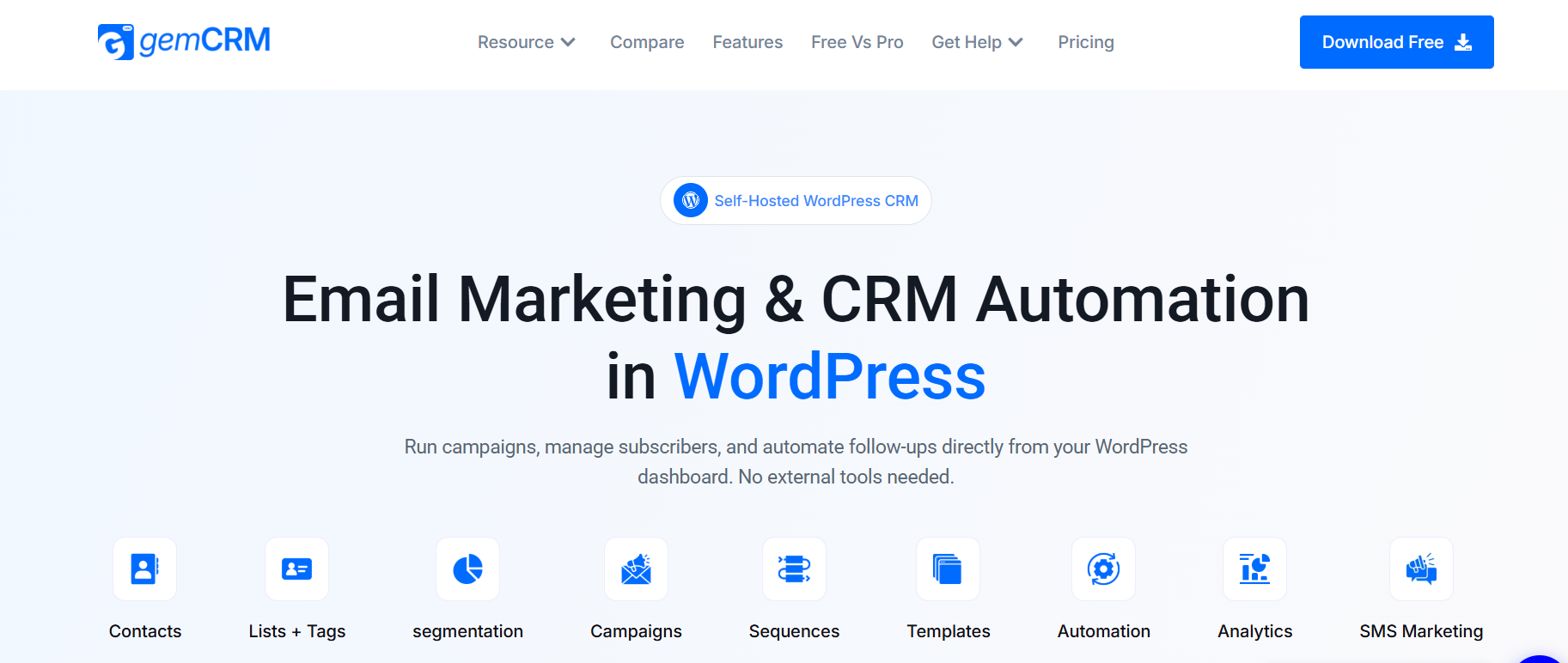
GemCRM is built specifically for WordPress. Unlike tools that treat WordPress as an afterthought, GemCRM was designed from the ground up to work inside your dashboard — no API keys, no third-party syncing, no paying for contacts you’re not actively emailing.
It combines CRM functionality, email list management, campaign creation, and automation into a single plugin. No stitching together four separate tools and hoping the Zapier connection holds.
What makes GemCRM stand out in 2026:
- Native WordPress integration — no external dependencies
- Built-in CRM to track subscriber activity and purchase history
- Visual drag-and-drop email builder with mobile-responsive templates
- Smart segmentation based on behavior, tags, and WooCommerce order data
- Automation workflows with conditional logic (welcome sequences, cart recovery, re-engagement)
- GDPR-compliant subscriber management out of the box
- Scales from 100 to 100,000+ subscribers without platform price jumps
For WordPress site owners who want professional email marketing without leaving their dashboard — or paying enterprise pricing — GemCRM is the clearest choice in 2026.
Download the free version or check the pro tier for advanced automation.
2. FluentCRM — Best for Advanced Automation
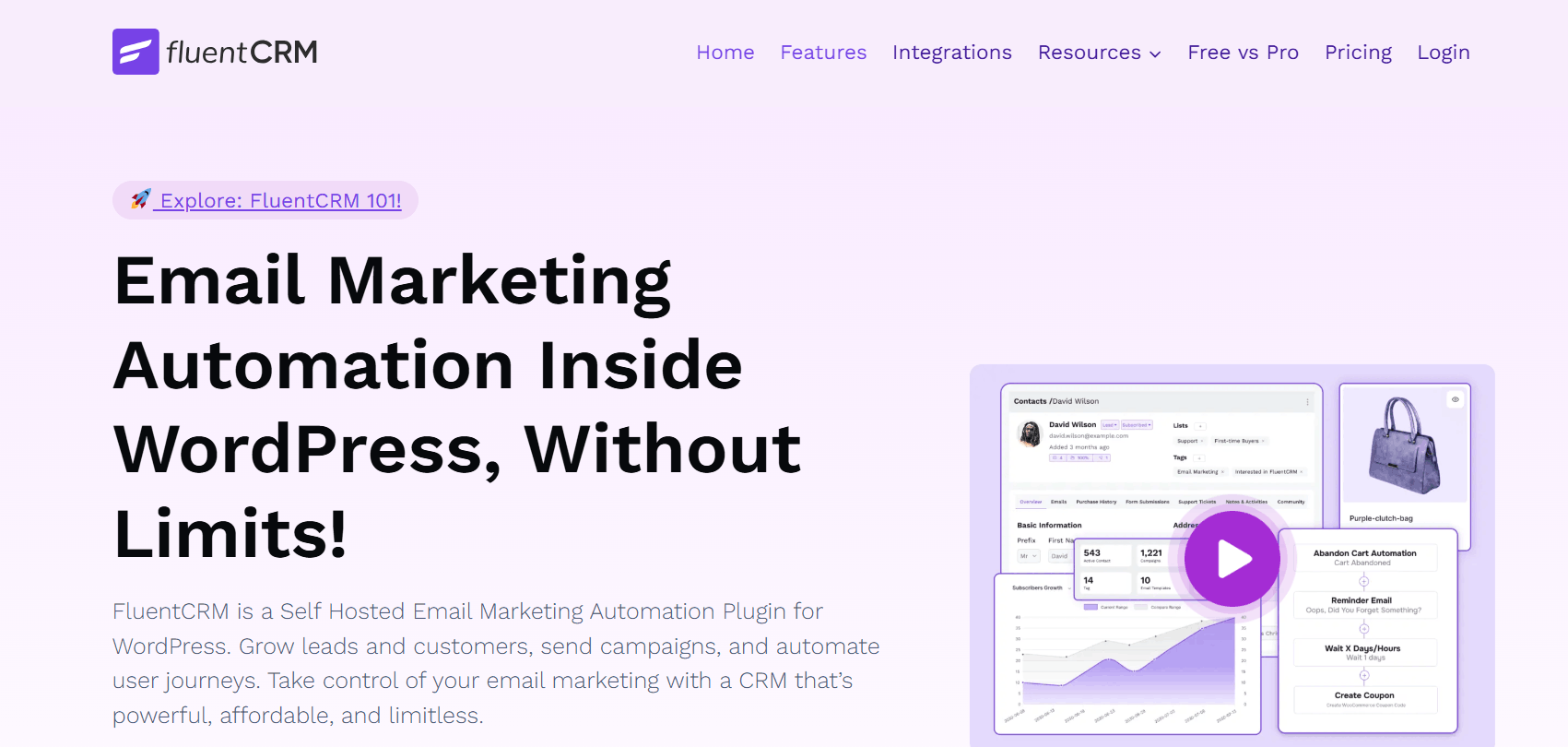
FluentCRM is a self-hosted CRM and email automation plugin. It’s powerful, developer-friendly, and great for membership sites, online courses, and WooCommerce stores that need complex automation.
The learning curve is real — this isn’t a beginner tool. But if your customer journey involves multi-stage onboarding or conditional branching, FluentCRM handles logic that simpler plugins can’t.
- Starts at $129/year
- All data is stored in your WordPress database
- Deep integration with LMS plugins (LearnDash, LifterLMS, TutorLMS)
- Not ideal for non-developers
3. MailPoet — Best for Newsletter Senders
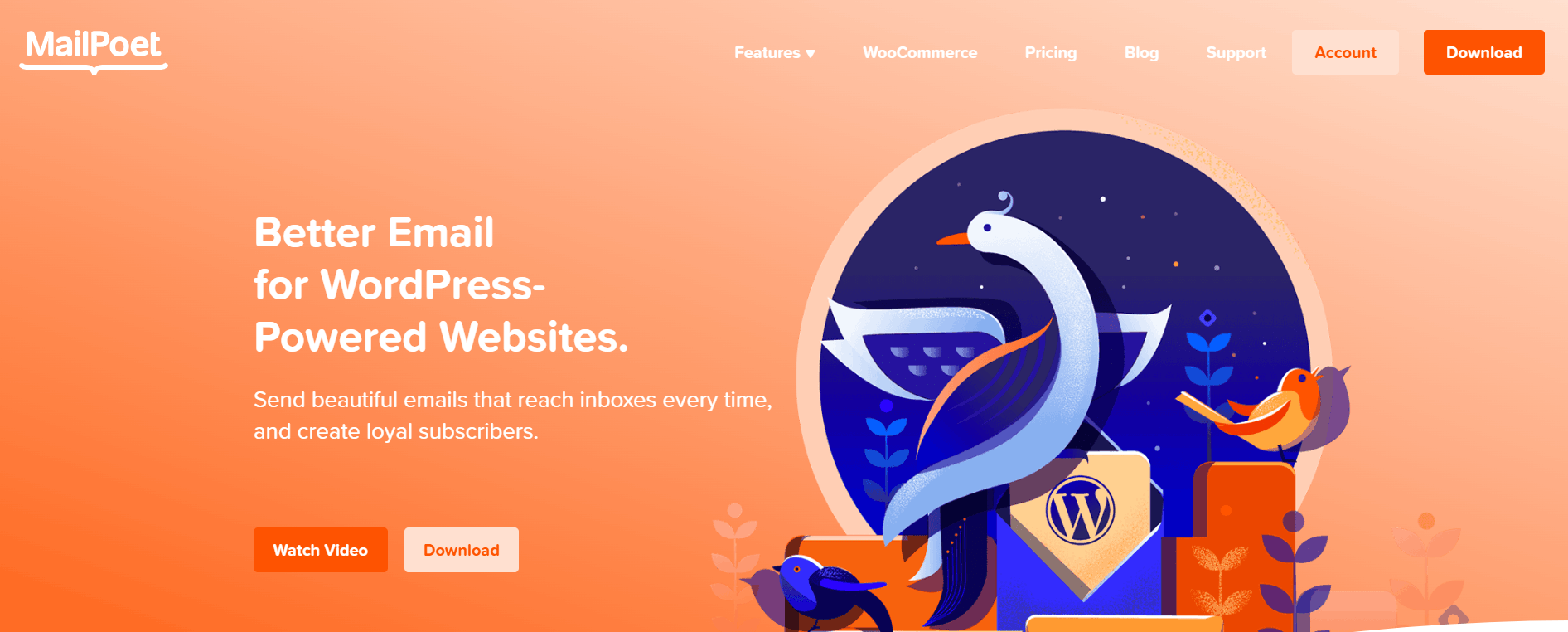
MailPoet is the go-to option for bloggers who primarily want to send newsletters — not build complex automation. Clean, easy to use, and the free plan is generous for smaller lists.
- Free up to 1,000 subscribers (with MailPoet branding)
- Paid plans from $10/month
- Good WooCommerce integration for basic post-purchase emails
- Limited automation depth
4. Brevo — Best SaaS Bridge Option
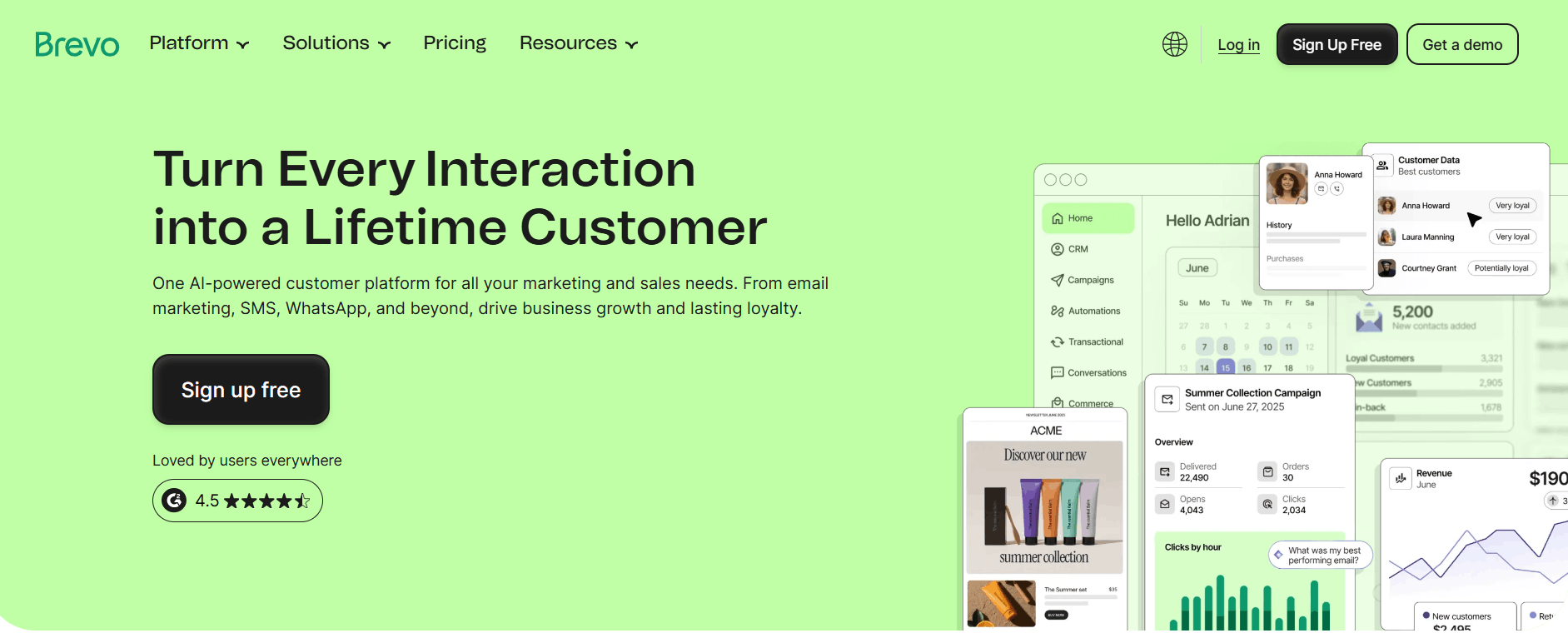
Brevo (formerly Sendinblue) isn’t a native WordPress plugin — it’s a full SaaS platform with a WordPress connector. Solid if you’re already on Brevo. But if you’re starting fresh and want everything inside WordPress, the external infrastructure adds unnecessary complexity.
- Free plan: 300 emails/day, unlimited contacts
- Paid plans from $9/month
- Data lives on Brevo’s servers, not yours
5. Omnisend — Best for WooCommerce Stores

Omnisend is purpose-built for ecommerce. If you need pre-built abandoned cart flows, product recommendation emails, and revenue attribution, Omnisend delivers. The downside: pricing scales quickly, and the feature depth is overkill for most content sites.
- Free plan: 500 emails/month to 250 contacts
- Paid plans from $16/month
- Best-in-class ecommerce automation
6. Mail Mint — Best AI Email Marketing Plugin for WooCommerce
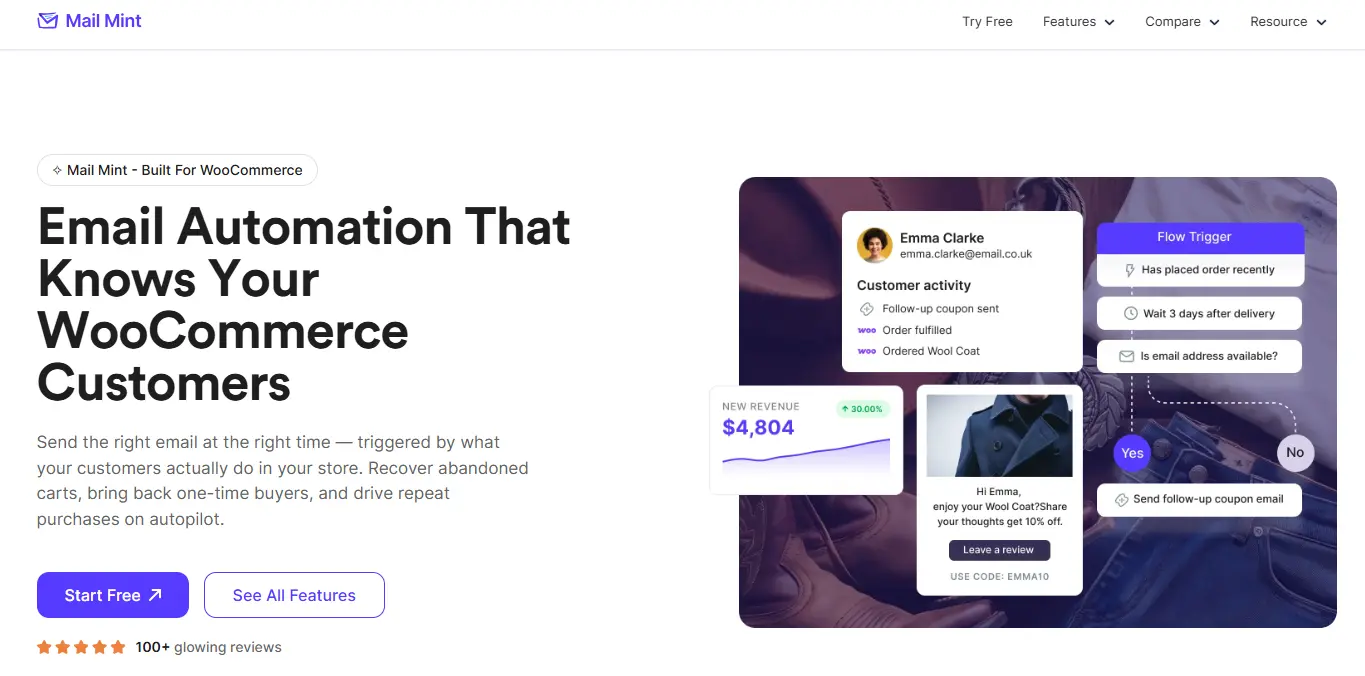
Mail Mint is a WordPress and WooCommerce email marketing plugin with an AI email engine that lets you create campaigns, automations, segments, A/B tests, emails, and subject lines with a simple prompt. Instead of building everything from scratch, you tell Mail Mint what you want, review what it creates, and send it. It also works with WooCommerce data, making it easier to personalize campaigns, recover abandoned carts, and bring previous customers back.
- Free with unlimited contacts
- Paid plans from $149.99/year
- Self-hosted — customer and campaign data stays on your server
Plugin Comparison Table
|
Feature |
GemCRM |
FluentCRM |
MailPoet |
Brevo |
Omnisend |
|
Native WordPress |
✅ Yes |
✅ Yes |
✅ Yes |
⚠️ Bridge (via plugin) |
⚠️ Bridge (via plugin) |
|
Built-in CRM |
✅ Yes |
✅ Yes |
❌ No |
✅ Yes |
⚠️ Basic |
|
Free Plan |
✅ Yes (Limited) |
❌ No (Pro only) |
✅ Up to 500 subs |
✅ 300 emails/day |
✅ 500 emails/mo (250 contacts) |
|
WooCommerce |
✅ Deep |
✅ Deep |
✅ Good |
✅ Good |
✅ Best (eCommerce) |
|
Automation |
✅ Yes |
✅ Advanced |
⚠️ Basic |
✅ Good |
✅ Good |
|
Data Ownership |
✅ Your DB |
✅ Your DB |
✅ Your DB |
❌ Their server |
❌ Their server |
|
Starting Price |
Free / $119 Lifetime |
$129/yr |
Free |
$9/mo |
$16/mo |
How to Choose the Right Plugin
Choosing the best email marketing plugin depends on your specific needs. Here’s a quick guide:
- Blogger or Content Creator → GemCRM or MailPoet GemCRM is ideal if you want room to grow into advanced automation and CRM features without switching platforms later.
- WooCommerce Store Owner → GemCRM or Omnisend Choose GemCRM for full in-house control and data ownership. Go with Omnisend if you want the deepest eCommerce automation (SMS + email, advanced abandoned cart, etc.).
- Online Courses or Membership Sites → FluentCRM Best for handling complex student/member journeys, drip campaigns, and advanced segmentation.
- Full Data Control + GDPR Compliance → Any self-hosted option (GemCRM, FluentCRM, or MailPoet). These keep all your subscriber data in your own WordPress database.
- Tight Budget → Start with the GemCRM free plan or the MailPoet free tier. Both are solid entry points and let you scale without high upfront costs.
Benefits of Building Your Email List in WordPress
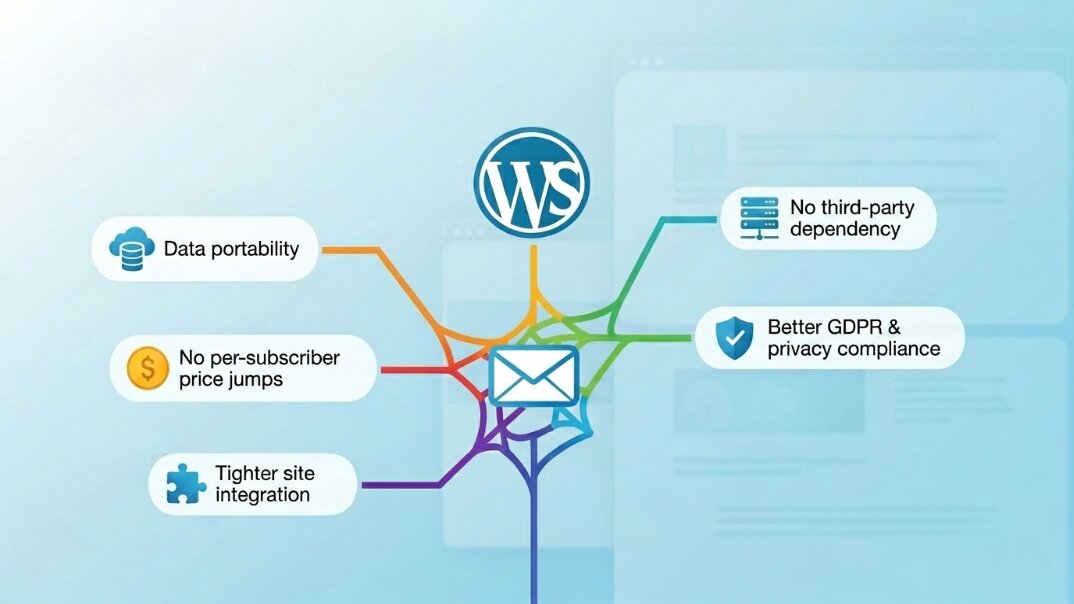
Building your email list natively inside WordPress gives you several powerful advantages that SaaS platforms simply can’t match:
- Data portability — Your subscriber list lives in your own database. You can export it anytime and migrate it anywhere without restrictions.
- No per-subscriber price jumps — Most SaaS tools increase pricing as your list grows. Self-hosted plugins (like GemCRM) don’t penalize you for success.
- Tighter site integration — Subscriber behavior (page visits, WooCommerce purchases, form submissions) can trigger emails instantly without API delays or sync issues.
- No third-party dependency — If Mailchimp, Brevo, or any external service goes down or changes their API/terms, your campaigns aren’t affected. Your plugin runs on your site.
- Better GDPR & privacy compliance — You have full control over where and how subscriber data is stored and processed — a big advantage as regulations continue to tighten.
What’s Coming in 2027
The email marketing landscape is evolving rapidly. Here’s what forward-thinking WordPress site owners and marketers should prepare for:
- AI-personalized send times and content — Real-time behavioral prediction and hyper-personalization are becoming standard. AI will optimize not just what subscribers see, but exactly when they’re most likely to engage.
- Interactive emails (AMP for Email & beyond) — Subscribers will be able to complete forms, browse products, update preferences, and even make purchases directly inside the email without leaving the inbox.
- Zero-party data collection — Preference centers, quizzes, polls, and interactive experiences will replace declining cookie-based tracking as the primary way to gather reliable insights.
- Deeper WooCommerce integration — Predictive reorder triggers, lifetime value (LTV) segmentation, and advanced behavioral loops will become table stakes for eCommerce stores.
- Privacy-first infrastructure — Self-hosted plugins with full data ownership and in-country server options will gain a significant compliance and trust advantage as regulations tighten.
Conclusion
Social algorithms will keep changing. Ad costs will keep climbing. But your email list? That’s yours.
With email marketing delivering $42 back for every $1 spent and an industry headed toward $17.9 billion by 2027, the question isn’t whether email marketing works. The question is whether you’re set up to take advantage of it.
The best email marketing plugin for WordPress in 2026 is the one that grows with you — not the one that charges you more every time you do.
For most WordPress users, that plugin is GemCRM.
It’s built for WordPress. It keeps your data on your server. It combines CRM, list management, and automation in one clean dashboard. And it doesn’t punish you for growing your list.
Frequently Asked Questions
What is the best free email marketing plugin for WordPress?
GemCRM and MailPoet both offer strong free tiers. GemCRM is better if you plan to scale into automation; MailPoet is simpler for basic newsletters.
Is FluentCRM better than MailPoet?
For automation depth, yes. But MailPoet is much easier to set up. For most small businesses that want something in between, GemCRM hits the sweet spot.
Can I do email marketing in WordPress without a third-party service?
Yes. Self-hosted plugins like GemCRM and FluentCRM store all subscriber data in your WordPress database. You’ll need an SMTP service (Amazon SES, SendGrid) for delivery, but your data stays on your server.
Is GemCRM good for small businesses?
Yes — GemCRM is designed specifically for WordPress-based small businesses. It combines CRM, email marketing, and automation in one plugin, so you don’t need separate tools as you grow.