

Your marketing brings in leads every week. Your sales team says most of them are not ready to buy. Marketing says sales never follows up fast enough. Both sides may be right, and the problem is usually the space between them.
A marketing and sales funnel fills that space. It shows how a stranger becomes a customer, who is responsible at each step, and when a lead should move on. This guide explains the stages, a simple strategy, and how a CRM keeps everything on track.
Quick Overview
What Is a Marketing and Sales Funnel?
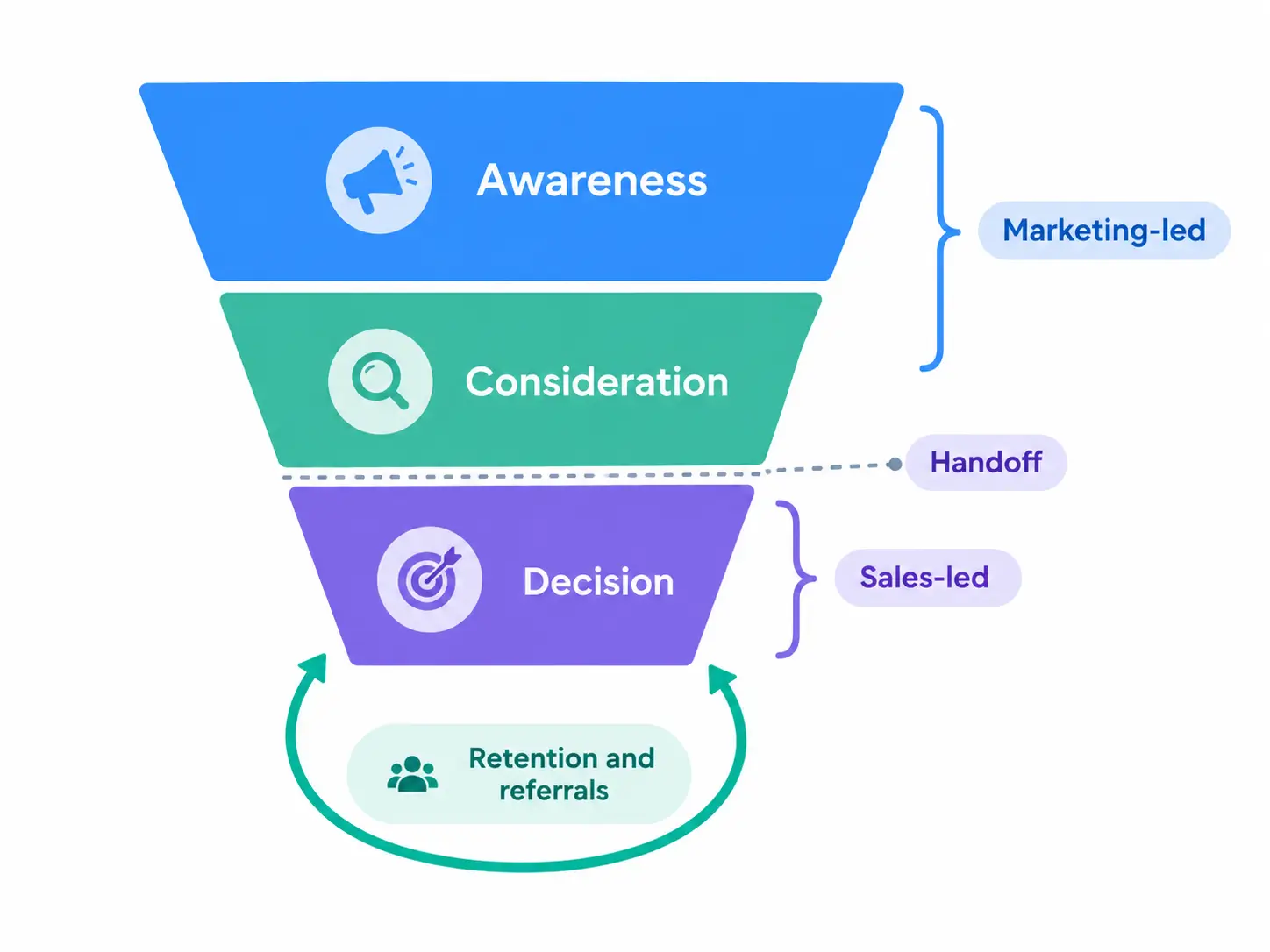
A marketing and sales funnel is a model of the path people take before they buy. Many people enter at the top. Fewer move through each stage. The narrowing shape is why it is called a funnel.
Two parts make up the whole. The marketing funnel attracts people and builds trust until they show real interest. The sales funnel takes those interested leads and helps them decide. Some sources treat the sales funnel as the bottom of the marketing funnel. Others treat them as separate. Both views are useful, and the labels matter less than the handoff.
The funnel idea is old. Wikipedia’s overview of the marketing funnel notes that it was tied to the AIDA model in the 1920s and that many versions have appeared since. That is why you will see three stages on one site and six on another.
Marketing Funnel vs. Sales Funnel
The funnels answer different questions. Marketing asks, “How do we attract the right people?” Sales asks, “How do we help this person decide?”
|
Marketing Funnel |
Sales Funnel |
|
|
Goal |
Generate and nurture qualified leads |
Turn qualified leads into customers |
|
Typical stages |
Awareness, interest, consideration |
Qualification, discovery, proposal, closing |
|
Main activities |
Content, email, social, forms, ads |
Calls, demos, quotes, negotiation |
|
Style |
One-to-many, content-led |
One-to-one, conversation-led |
|
Owner |
Marketing |
Sales (or the business owner) |
|
Key metrics |
Traffic, lead conversion rate, qualified leads |
Win rate, deal size, sales cycle length |
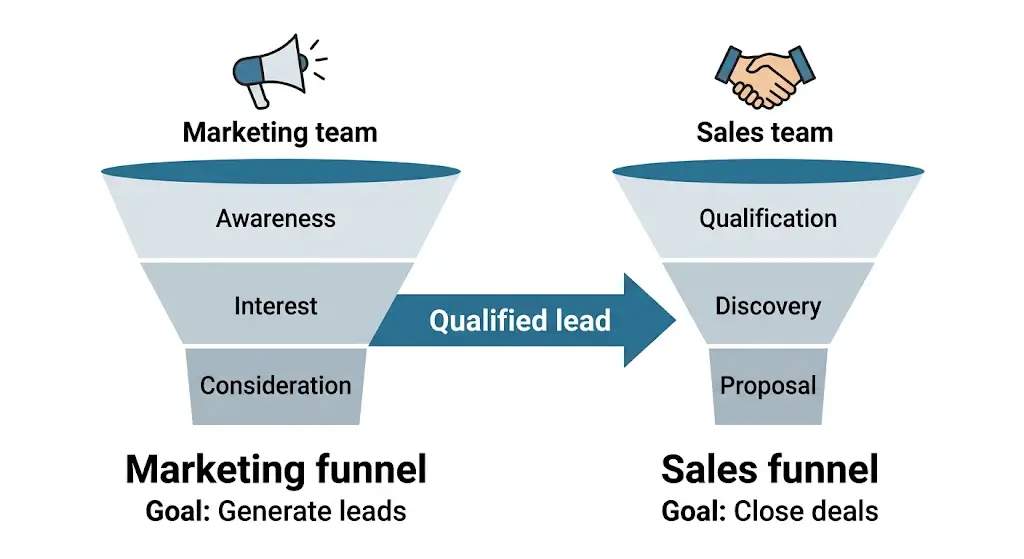
Where the funnels connect. A lead moves from marketing to sales when it meets your qualification rules. Before that point, the lead is a subscriber. After it, the lead is a sales opportunity. Without clear rules, leads either sit untouched or reach sales too early.
Small businesses often run both funnels with the same two or three people. That is fine. You still gain from naming the two jobs, because it stops you from chasing cold leads or ignoring warm ones.
Marketing and Sales Funnel Stages
This guide uses three main stages: top, middle, and bottom of the funnel (TOFU, MOFU, and BOFU). It adds a fourth for the time after the sale. If your business uses five or six stages, you can still map them onto this model.
Stages also vary by business. A B2B company may have long cycles with several decision-makers. An online store may move a shopper from product page to checkout in one visit. Treat each stage as a prompt to ask what the buyer needs next.
Top of the Funnel (TOFU): Awareness
What the customer is doing: They have a problem and are searching for answers. They may not know your brand yet.
Marketing’s role: Be easy to find. Publish helpful blog posts, videos, and search-friendly pages. Focus on the problem, not your product.
Sales’ role: Mostly none. Sales can share what customers ask on calls, which helps marketing pick topics.
Useful content: Guides, how-to posts, short videos, social posts.
Metric to watch: Organic traffic.
Middle of the Funnel (MOFU): Interest and Consideration
What the customer is doing: They know you exist. Now they compare options and test whether you can be trusted.
Marketing’s role: Capture an email address in exchange for something useful, such as a checklist or template. Then nurture with relevant emails. Share case studies, comparison pages, and FAQs.
Sales’ role: Qualify the lead. Check budget, need, timing, and who makes the decision. A form question, a short call, or a pricing-page visit can all help.
Useful content: Case studies, comparison pages, webinars, welcome email series.
Metric to watch: Lead conversion rate, and the share of leads that become qualified.
Bottom of the Funnel (BOFU): Decision and Closing
What the customer is doing: They are close to choosing. They want proof, clear pricing, and answers to last doubts.
Marketing’s role: Support sales with proof. Keep pricing pages clear and forms short. Retarget interested visitors.
Sales’ role: Run a discovery conversation, show how your product fits their problem, and send a proposal or quote. Negotiate terms if needed. Record the deal as won or lost, and write down why.
Useful content: Demos, free trials, testimonials, proposals.
Metric to watch: Win rate.
After the Sale: Retention and Advocacy
What the customer is doing: They are using what they bought. They decide whether to buy again or recommend you.
Marketing’s role: Send onboarding emails, tips, and occasional offers.
Sales’ role: Check in, help with problems, and spot upgrade chances.
Useful content: Onboarding series, how-to guides, review requests, loyalty offers.
Metric to watch: Repeat purchase rate.
How to Build a Marketing and Sales Funnel Strategy
You do not need a complex diagram. You need clear answers to six questions.
1. Define Your Audience and Buyer Journey
Write down who you serve, what problem they have, and where they look for help. Then list the real steps people take before they contact you. Ask recent customers how they found you and what almost stopped them. Their answers beat any template.
2. Set a Goal for Each Stage
Give every stage one measurable goal. For example, you might aim for 5% of visitors to join your list. Another goal could be that 20% of subscribers reach your pricing page. Use your past data to set targets. If you have none, treat your first three months as a baseline.
3. Choose Content and Channels
Match content to what the buyer needs at that stage. Early on, they need education. Later, they need proof. Pick two or three channels you can maintain, such as search, email, and one social platform. A small funnel that runs well beats a big one that stalls.
4. Set Qualification and Handoff Rules
This is the step most guides skip. Write down when a lead becomes ready for sales. A simple rule might be:
Then decide who follows up, by what method, and how fast. Speed matters because interest fades. If you are a solo owner, write the rule anyway. It will tell you which leads deserve a personal message today.
5. Plan Follow-Ups
Most leads are not ready on day one. Plan a short email series for each major lead type, such as new subscribers, trial users, and quiet leads. Add personal follow-ups for high-value leads. For a deeper look at triggers, journeys, and exit rules, see our guide on building a marketing automation funnel.
6. Measure and Fix the Biggest Drop-Off
Compare each stage with the next. The biggest drop is your best opportunity. If few visitors join your list, test a new offer. If many leads never reach sales, review your qualification rules. Change one thing at a time so you know what worked.
Marketing and Sales Funnel Example
Here is one illustrative example. It is made up, and real buyers rarely follow a straight line. Imagine a small agency that sells website maintenance plans.
|
Step |
What happens |
Purpose |
|
1. Discovery |
A visitor finds a post about speeding up WordPress through Google. |
Awareness |
|
2. Lead capture |
They download a free site speed checklist and join the email list. |
Turn a visitor into a contact |
|
3. Nurturing |
Marketing sends three emails: quick wins, a customer story, and a plan overview. |
Build trust |
|
4. Buying signal |
The lead visits the pricing page twice. |
Show rising interest |
|
5. Sales follow-up |
The owner sends a short personal note and offers a call. |
Handoff and discovery |
|
6. Conversion |
After the call, the lead picks a monthly plan. |
Close the sale |
|
7. Retention |
The customer gets onboarding tips and a check-in after 60 days. |
Repeat business and referrals |
Notice how each step uses information from the step before. The checklist download tells marketing what the lead cares about. The pricing visits tell the owner when to reach out. Many visitors will skip steps or leave, and that is normal.
How CRM Supports a Marketing and Sales Funnel
A funnel on paper is simple. Running it every day is harder. A CRM (customer relationship management) tool remembers who is where, so you do not have to. It does not replace your strategy. It makes the strategy repeatable.
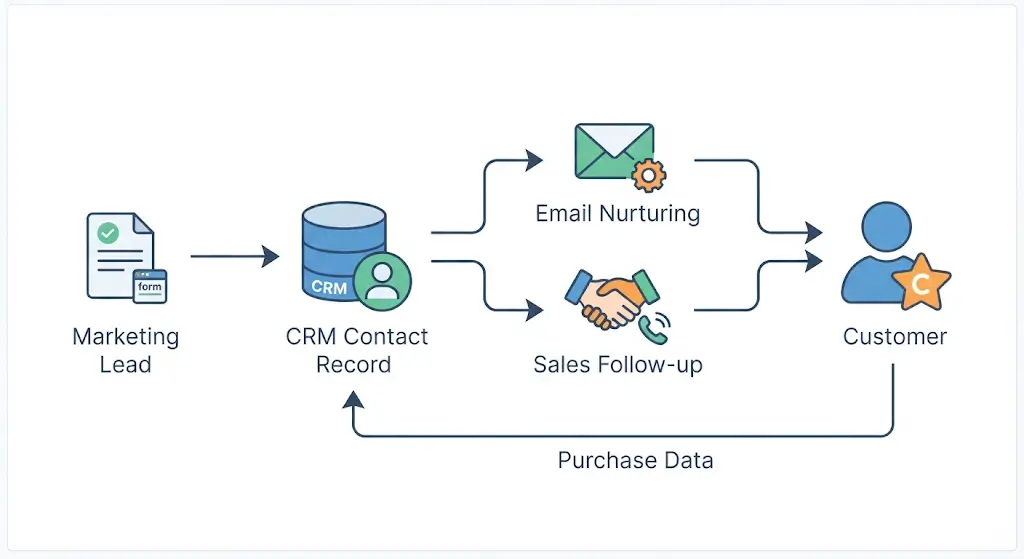
It keeps customer data in one place. Without a CRM, leads live in spreadsheets, inboxes, and form plugins. A CRM gives each person one record with their details, source, and activity. In GemCRM, you place a form on your WordPress site and submissions become contacts automatically. The subscription forms guide shows the setup.
It tracks funnel progress. In the free plugin, tags and lists work well as stage markers. You might tag a contact “Downloaded checklist” and later “Sales ready.” For sales-led businesses, GemCRM Pro adds a Deals pipeline. Deals sit on a drag-and-drop board by stage, with notes, tasks, and activity history.
It supports segmentation and follow-ups. The free plugin includes an email campaign builder for one-time sends. GemCRM Pro adds Email Sequences, which send a series of emails over time, plus Dynamic Segments. Segments update as contact data changes, so a lead who gets a new tag can move into a new group automatically.
It keeps marketing and sales aligned. Both teams see the same contact and history. You can also use the free Zaplane companion plugin to react when something changes. Its GemCRM automation guide explains how. For example, you could email yourself when a contact gets the “Sales ready” tag.
A note on funnel vs. pipeline. People often mix these up. A funnel describes the whole buyer journey. A pipeline tracks individual deals through your sales steps. You will usually use tags and campaigns for the funnel and the pipeline for active deals.
Marketing and Sales Funnel Metrics to Track
The stages section named one metric per stage. This table shows how to define it and what it helps you find. Compare your numbers with your own past results first. Benchmarks vary a lot by industry and price.
|
Stage |
Metric |
How to calculate it |
What it helps you find |
|
Awareness |
Organic traffic |
Visits from unpaid search |
Whether your content is being found |
|
Lead generation |
Lead conversion rate |
Leads ÷ visitors |
Whether your offer and forms work |
|
Nurturing |
Email click rate |
Clicks ÷ emails delivered |
Whether your follow-ups interest leads |
|
Nurturing |
Qualified leads |
Leads that meet your handoff rule |
Whether marketing sends sales the right people |
|
Sales |
Win rate |
Deals won ÷ deals closed |
Whether sales conversations convert |
|
Sales |
Sales cycle length |
Average days from first contact to close |
Where deals stall |
|
Retention |
Repeat purchase rate |
Customers who buy again ÷ all customers |
Whether customers stay happy |
In GemCRM, campaign reports show opens and clicks for each send. That covers the nurturing rows.
Common Funnel Mistakes and How to Fix Them
The handoff and drop-off problems appear above. These are the other mistakes worth avoiding.
Frequently Asked Questions
Is a sales funnel the same as a sales pipeline?
No. A funnel is a model of the full buyer journey, including people who are only browsing. A pipeline lists specific deals and their current steps. Funnels help you plan. Pipelines help you manage live deals.
Do small businesses need both funnels?
You need both jobs, but not two separate systems. Many small teams run one combined funnel. Marketing tasks cover the top and middle. Sales tasks cover the bottom. What matters is that someone owns each step.
How many stages should a funnel have?
Use as few as you can while still being useful. Three to five is common. Add a stage only when it changes what you do. If two stages call for the same action, merge them.
How can I improve my funnel conversion rate?
Find the stage with the biggest drop-off and fix it first. Common fixes include a clearer offer, shorter forms, faster follow-up, and more relevant emails. Test one change at a time so you can see what worked.