



If you’re running a WordPress website and are tired of paying monthly SaaS fees to platforms like HubSpot or Mailchimp just to manage your own subscriber list, you’re not alone. In 2026, the shift toward self-hosted WordPress CRMs has accelerated — and two names keep coming up in that conversation: GemCRM and Groundhogg.
Both live inside your WordPress dashboard. Both give you full data ownership. Both promise to cut your CRM bills dramatically. But they are not the same tool, and choosing the wrong one could mean paying for features you don’t need — or missing features you absolutely do.
In this comparison, we’ll break down every major dimension: features, pricing philosophy, ease of use, integrations, automation capabilities, and who each tool is actually built for. Because GemCRM is one of the newer tools in the space, we’ll give it the close-up examination it deserves.
What Is GemCRM?
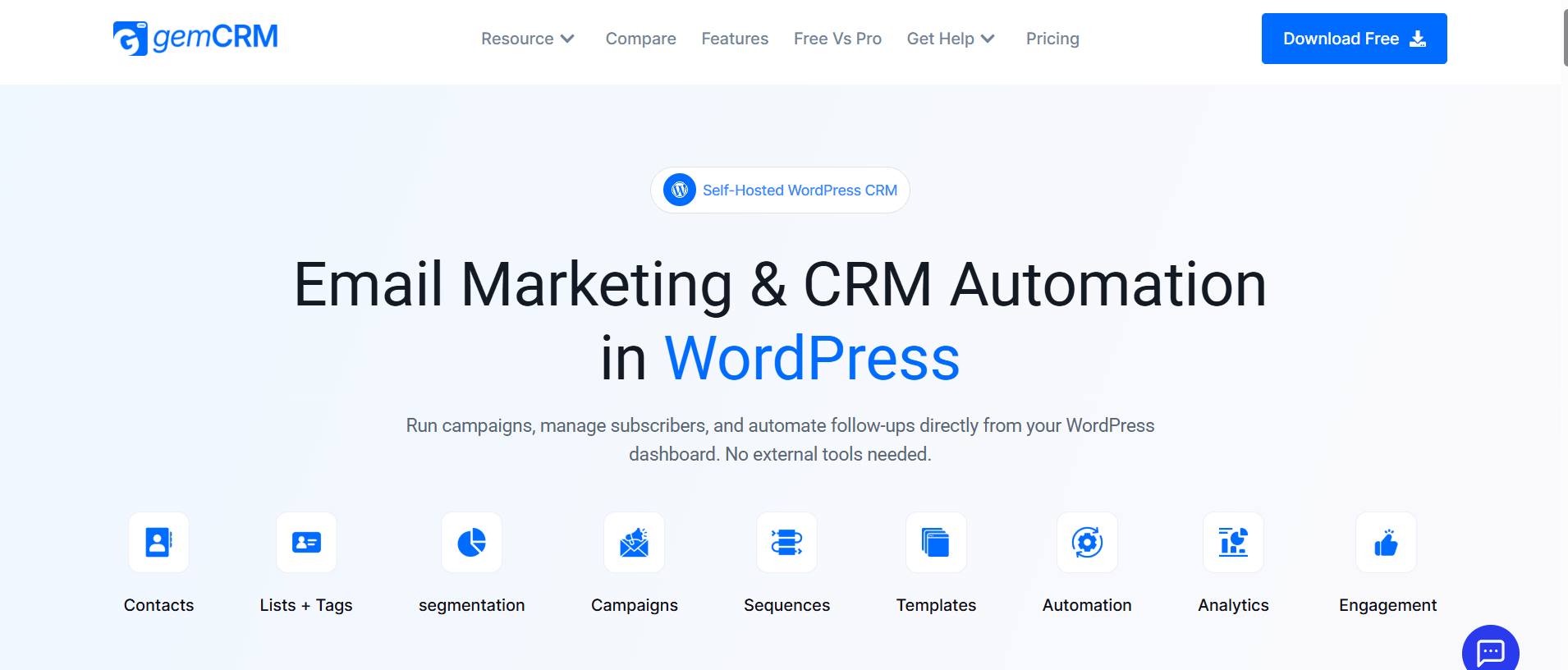
GemCRM is a WordPress-native CRM plugin built by the team behind Academy LMS. Its core mission: run campaigns, manage subscribers, and automate follow-ups directly from your WordPress dashboard, with no external tools needed.
What makes GemCRM genuinely distinct is its foundational approach to WordPress integration. The plugin auto-syncs with WordPress user roles, captures leads directly from comment submissions, and automatically maps user roles to subscriber tags. This isn’t a bolt-on CRM that happens to work with WordPress — it treats WordPress events, users, and engagement as first-class triggers.
GemCRM uniquely turns WordPress engagement like comments into CRM contacts automatically, unlocking organic lead capture that others miss.
For content publishers and course creators, this is a meaningful differentiator: every comment, registration, or purchase can feed directly into your CRM without a third-party form plugin. The plugin’s roadmap includes smart links, dynamic segmentation, and abandoned cart automation.
GemCRM is ideal for: WordPress publishers, course creators, LMS site owners, agencies managing multiple client sites, and anyone prioritizing long-term cost control over cutting-edge automation complexity.
What Is Groundhogg?
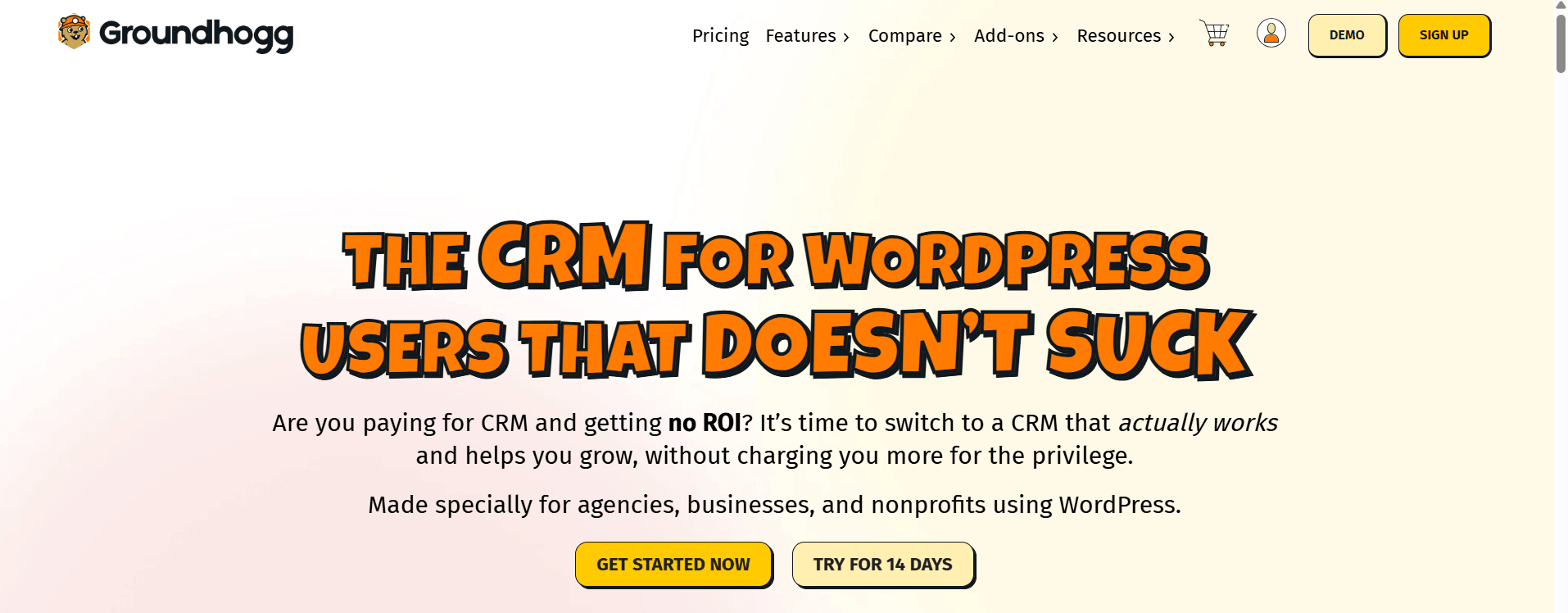
Groundhogg is one of the most established self-hosted CRM plugins for WordPress, built with agencies, developers, and scaling businesses in mind. It is the only fully GPL-licensed CRM plugin for WordPress, meaning you own the code outright and can modify, redistribute, or white-label it without restriction.
Version 4.0, released in March 2025, was a landmark update. It introduced a redesigned flow editor that modernized the entire automation experience, bringing a visual, drag-and-drop interface that makes Groundhogg competitive with dedicated automation platforms.
Businesses that switch to Groundhogg save on average $240 per month on CRM fees — positioning it as a direct, self-hosted alternative to ActiveCampaign, HubSpot, and Keap.
Groundhogg is ideal for: Agencies needing white-label CRM solutions, WordPress developers who want full code access, WooCommerce stores, and businesses with compliance needs that require complete data sovereignty.
Feature-by-Feature Breakdown
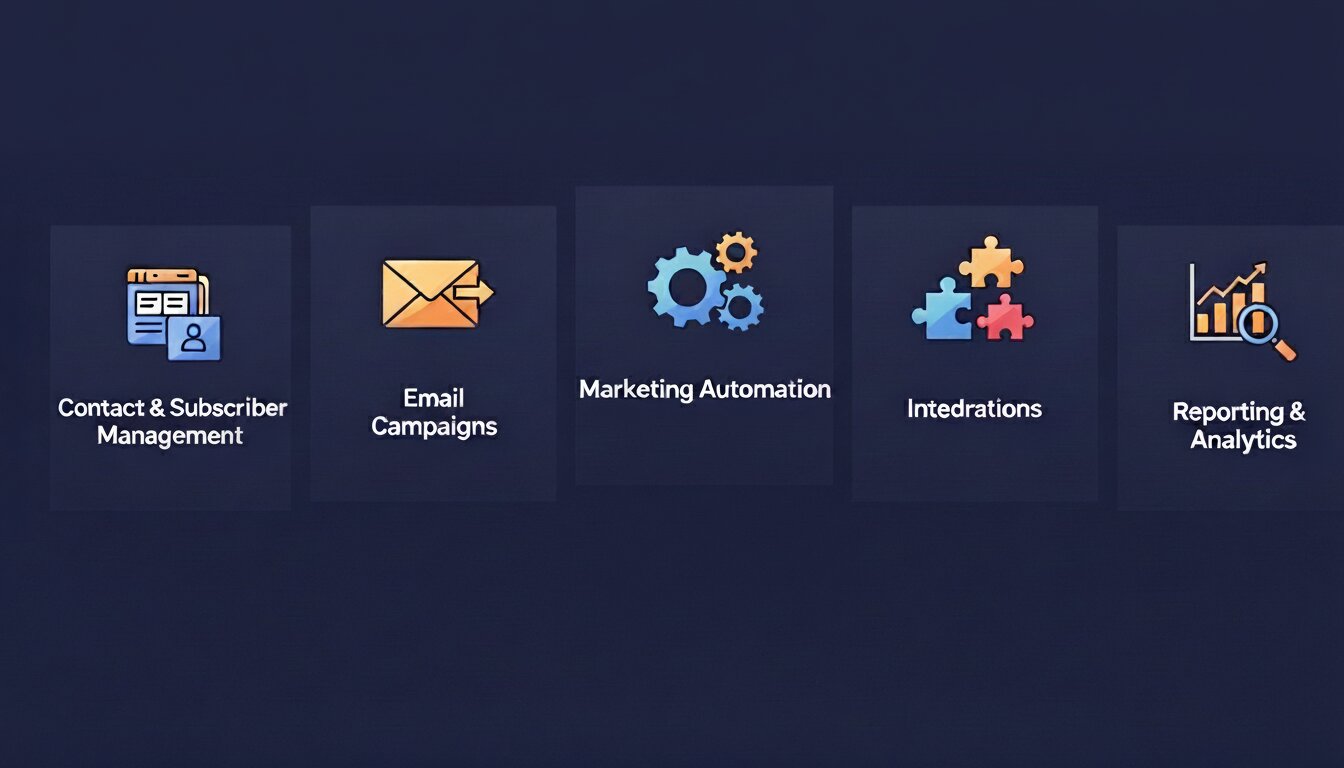
1. Contact & Subscriber Management
GemCRM provides a clean dashboard to view subscribers, lists, and tags, with easy tools to add, edit, resend, or import contacts. Segmentation currently uses static list and tag filters — dynamic behavior-based segmentation is on the roadmap, but not yet live.
Groundhogg goes further right now. It includes lead scoring that automatically categorizes contacts as hot, warm, or cold based on engagement, and contact profiles are enriched with activity timelines, custom fields, and engagement history.
Winner: Groundhogg (for now — GemCRM’s dynamic segmentation is coming)
2. Email Campaigns
GemCRM lets you send one-time or recurring emails, use ready templates or create from scratch, and create step-by-step follow-up sequences. Double opt-in verification is built in for list hygiene.
Groundhogg adds A/B split testing on email campaigns, which GemCRM doesn’t currently offer. Its email editor has matured over the years of user feedback, with more advanced targeting options.
Both tools support broadcast emails and recurring campaigns.
Winner: Tie for basics; Groundhogg edges ahead for A/B testing and advanced targeting.
3. Marketing Automation
This is where the two tools diverge most meaningfully. GemCRM offers WordPress-native automation logic — roles, users, comments, and engagement — instead of relying on external data pipelines. Email sequences, drip campaigns, and follow-up triggers based on WordPress events are all functional. Complex multi-branch logic is still in development.
Groundhogg’s v4.0 Flow Editor is genuinely powerful. It automates interactions through flows that trigger emails, SMS messages, and tag applications based on user behavior. Advanced logic includes yes/no branching, multi-branching, and split testing, making flows significantly more powerful for complex scenarios.
Winner: GemCRM for simple, WordPress-native workflows; Groundhogg for complex automation.
4. Integrations
GemCRM integrates natively with StoreEngine and other WordPress-based eCommerce tools. Because it’s built by the Academy LMS team, deep LMS integration is a core focus. Broader integrations are growing on the roadmap.
Groundhogg has a broader portfolio today: native integrations with WooCommerce, LearnDash, MemberPress, Easy Digital Downloads, and WPForms, plus a REST API and webhooks. See the full Groundhogg integration list for details.
Winner: GemCRM for Academy LMS-specific workflows; Groundhogg for integration breadth.
5. Reporting & Analytics
GemCRM provides basic campaign reporting covering open rates, click tracking, and subscriber growth. The dashboard is clean and accessible for non-technical users.
Groundhogg delivers robust reporting, including email performance, flow analytics, WooCommerce revenue tracking, and custom reports with advanced filters. For data-driven teams, it’s the more capable reporting layer.
Winner: Groundhogg.
Pricing Comparison
GemCRM Pricing
All plans include unlimited contacts, campaigns, automation, and integrations with no hidden fees.
GemCRM uses a one-time lifetime license model — you pay once and own the plugin forever, including future updates. A 14-day money-back guarantee covers your purchase if it doesn’t fit your needs.
For agencies and WordPress businesses, the math is especially compelling. Instead of paying recurring fees year after year (like $129/year for FluentCRM per site), a single lifetime license turns that ongoing expense into a fixed, predictable cost. Most users see the lifetime model pay for itself within just 1–2 years compared to annual subscriptions.
The current early-bird pricing offers the best rates — typically before the product fully exits beta.
Explore current pricing at gemcrm.net/price.
Groundhogg Pricing
Groundhogg uses a flat-rate annual pricing model based on the features and extensions you need. Plans range from $20/month (Basic) to $100/month (Agency) when billed annually.
A $1 sandbox trial lets you test the Pro Plan risk-free for 14 days before committing.
Email sending costs are kept separate and very affordable. Using AWS SES, you pay only $0.10 per 1,000 emails. For example, a business with 5,000 subscribers sending 80,000 emails per month pays roughly $8 per month in sending costs — a fraction of what many traditional CRMs charge.
The Agency plan includes white-label branding and access to the partner program, which offers up to 30% recurring commissions on client referrals.
See all plans at groundhogg.io/pricing.
Pricing Summary
|
Feature |
GemCRM |
Groundhogg |
|
Pricing Model |
Lifetime (one-time) |
Annual subscription |
|
Starting Price |
One-time beta / early-bird fee (Solo: $119, regular $299) |
~$240/year (Pro plan, billed annually) |
|
Contacts Limit |
Unlimited |
Unlimited |
|
Campaigns Limit |
Unlimited |
Unlimited |
|
Refund Policy |
14-day money-back guarantee |
$1 sandbox trial (14 days for Pro Plan) |
|
White Label |
Not yet |
Yes (Agency plan) |
|
Long-term Cost |
Fixed, predictable (pay once) |
Recurring annually |
|
A/B Testing |
On roadmap |
Yes |
|
Lead Scoring |
On roadmap |
Yes |
|
Flow Editor |
Basic sequences |
Visual v4.0 editor (advanced drag-and-drop) |
Pros & Cons
GemCRM Pros
- Lifetime pricing
- Beginner-friendly
- Lightweight & fast
- WordPress-native
- Clean UI
- No contact limits
GemCRM Cons
- Still in beta
- Fewer integrations (for now)
- Automation is not fully mature
Groundhogg Pros
- Advanced automation
- Open-source flexibility
- Unlimited contacts
- Developer-friendly
- Multi-site support
Groundhogg Cons
- Recurring cost
- Complex setup
- Add-ons required
- Heavier system load
Ease of Use
GemCRM has a clean, simplified dashboard designed for marketers and non-technical users. Its WordPress-first design means the learning curve is minimal for anyone already familiar with the WordPress interface. You don’t need to configure SMTP services manually or manage cron jobs out of the box.
Groundhogg is more powerful, but that power comes with complexity. Setup requires configuring SMTP services, setting up server-level cron jobs, and managing caching exclusions. Documentation assumes existing CRM knowledge, which can steepen the learning curve for beginners.
Winner: GemCRM for simplicity; Groundhogg for power users.
Data Ownership & Privacy
Both tools are fully self-hosted, meaning your data lives on your own server. Neither charges more as your list grows, and neither sends subscriber data to third-party servers. This makes both strong options for GDPR compliance and data sovereignty requirements.
Neither GemCRM nor Groundhogg will ever have access to your customers’ personal information. Your data stays in your WordPress database, under your control.
Winner: Tie.
Who Should Choose GemCRM?
GemCRM is the right choice if you:
- Want a lifetime, no-recurring-fee CRM that pays for itself over time
- Run a content site, blog, course platform, or LMS built on WordPress
- Need WordPress-native automation that responds to user roles, comments, and registrations without extra plugins
- Manage multiple client sites as an agency and want predictable fixed costs
- Are comfortable adopting a growing product in exchange for early-access pricing
Explore more: GemCRM Features | GemCRM Pricing | GemCRM Roadmap
Who Should Choose Groundhogg?
Groundhogg is the right choice if you:
- Need advanced visual automation with complex branching logic today
- Run a WooCommerce store and need deep ecommerce automation out of the box
- Are you a WordPress developer or agency that needs full GPL code access and white-label capability
- Have compliance requirements demanding complete data sovereignty with developer-level control
- Want A/B testing, lead scoring, and a visual sales pipeline available right now
Explore more: Groundhogg Official Site | Groundhogg Pricing
Final Verdict
These two tools are solving the same problem — expensive SaaS CRM fees eating into WordPress business margins — but from very different angles.
GemCRM wins on pricing transparency and long-term affordability. Its lifetime model, unlimited-everything approach, and deep WordPress-native design make it the smarter financial bet for site owners with a 3–5 year horizon. It’s genuinely well-suited for publishers, course creators, and agencies who want clean CRM functionality without the complexity tax.
Groundhogg wins on feature maturity and automation depth. Its v4.0 Flow Editor is the most powerful automation tool currently available in the WordPress-native CRM space. If your business depends on conditional logic, lead scoring, and multi-path customer journeys right now, Groundhogg delivers.
The honest recommendation: if you’re budget-conscious and building for the long term, lock in GemCRM’s lifetime deal while it’s still in beta pricing. If you need enterprise-grade automation today and can absorb an annual subscription, Groundhogg is the most complete self-hosted CRM solution in the WordPress ecosystem.
Frequently Asked Questions (FAQ)
Is GemCRM free to use?
GemCRM is not free, but it offers a one-time lifetime license — meaning you pay once and never again. All plans include unlimited contacts, campaigns, and automation with no hidden fees.
Does Groundhogg charge based on contact list size?
No. Groundhogg uses flat-rate pricing regardless of how many contacts you have. Your plan cost stays the same whether you have 500 or 50,000 subscribers.
Which tool is better for beginners?
GemCRM is more beginner-friendly. Its clean dashboard requires no SMTP setup or cron job configuration. Groundhogg is more powerful but has a steeper learning curve for non-technical users.
Can GemCRM replace Mailchimp or HubSpot?
For WordPress site owners, yes — GemCRM handles campaigns, sequences, and contact management natively inside WordPress. For enterprise-level marketing automation, Groundhogg is the closest replacement.