



If you’re running a WooCommerce store and feeling the pressure to automate your marketing, you’ve likely stumbled across two names: GemCRM and FunnelKit. Both promise to eliminate manual follow-ups, recover lost carts, and nurture customers on autopilot — but they’re built on fundamentally different philosophies. One is a rising WordPress-native CRM with a disruptive lifetime licensing model, versus a mature, feature-rich funnel and automation suite that comes with a noticeably higher ongoing cost.
This comparison cuts through the noise. We’ll zero in on what actually matters for WooCommerce store owners in 2026 — data ownership, automation depth, pricing, ease of use, and long-term scalability — and show why GemCRM is quietly emerging as the smarter pick for growth-focused stores.
What Is GemCRM?
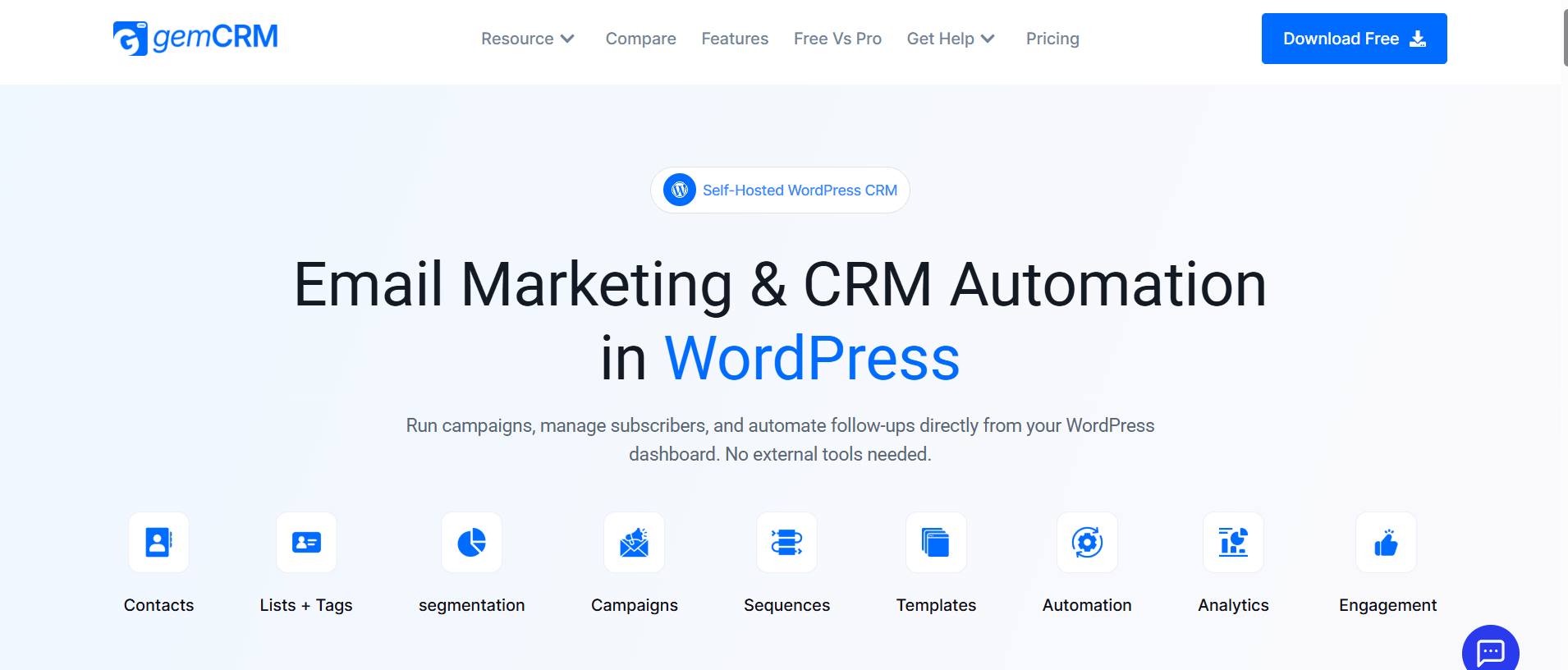
GemCRM is a WordPress-native CRM plugin built by the Academy LMS team. It takes a radically different approach from legacy tools: instead of connecting to an external dashboard or syncing data to a cloud platform, it runs entirely inside your WordPress installation. Your customer data, automation logic, and campaign history live on your server.
The core premise is refreshingly clear — manage your entire subscriber base, email campaigns, and customer follow-ups from inside the WordPress admin, with zero recurring fees and no data leaving your site.
What truly sets GemCRM apart isn’t any one feature — it’s its lifetime license model. Every plan includes unlimited contacts, email campaigns, automation workflows, and integrations, with no monthly or annual renewal costs. For store owners who’ve watched their SaaS bills compound year over year, this is a significant shift in how to think about marketing infrastructure.
Key GemCRM Features for WooCommerce
GemCRM’s WooCommerce integration is built around native WordPress behavior rather than external data pipelines. Here’s what that looks like in practice:
- WordPress-native lead capture: The plugin automatically syncs with WordPress user roles and turns comment submissions into CRM contacts — unlocking organic lead capture that most tools completely miss. A customer who comments on a product page becomes a lead without any opt-in friction.
- Role-based tag mapping: User roles are automatically mapped to subscriber tags, so WooCommerce customers, subscribers, and administrators get segmented the moment they interact with your site.
- Email drip sequences and recurring campaigns: Set up drip sequences for new buyers, post-purchase follow-ups, and recurring broadcast campaigns with list-level targeting, tag-based conditions, and user role filters.
- Unlimited contacts and campaigns: No tier restrictions or contact caps. A store with 500 customers and a store with 50,000 customers pay the same price.
- Data ownership: All subscriber data, automation logs, and campaign analytics remain on your WordPress server — important for GDPR compliance and businesses that want independence from vendor pricing decisions.
GemCRM is also deeply integrated with StoreEngine, a lightweight WooCommerce alternative, and Academy LMS, making it a natural fit for businesses running online courses alongside their eCommerce store.
What’s Still on the Roadmap?
Transparency matters here. GemCRM is a newer plugin that now includes automation workflows, dynamic segmentation, and abandoned cart automation. It also supports email sequences and recurring campaigns. Some advanced automation capabilities may still differ from those of more established platforms.
What Is FunnelKit?
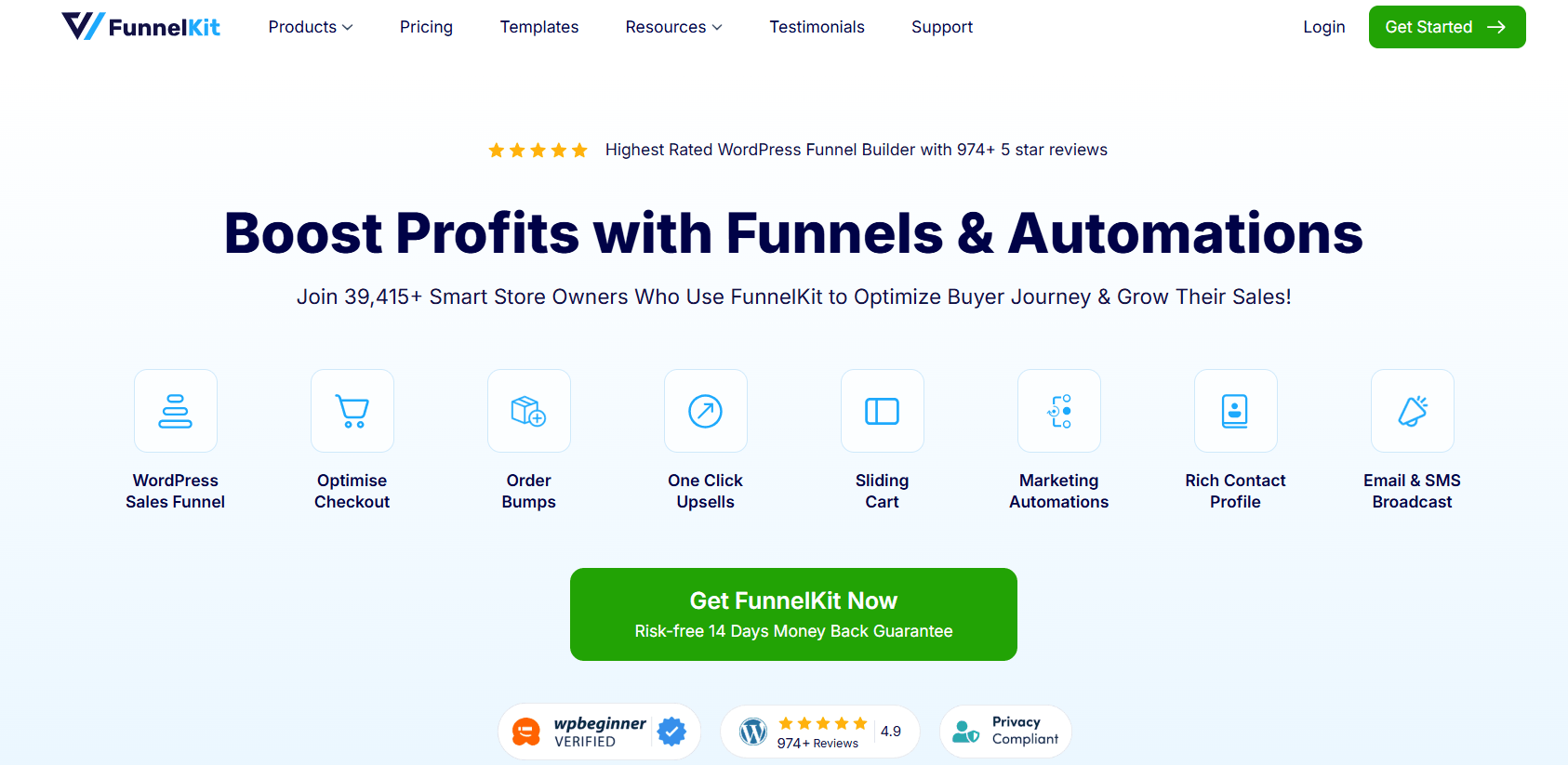
FunnelKit (formerly WooFunnels, rebranded in 2022) is a mature, all-in-one WooCommerce funnel and automation platform built by XLPlugins. It’s the power user’s tool — if GemCRM is a clean, focused knife, FunnelKit is a full Swiss Army toolkit.
FunnelKit bundles a funnel builder, checkout optimization, CRM, email marketing, SMS automation, and A/B testing into a single plugin suite. It’s what you’d reach for if your WooCommerce conversion rate has plateaued and you want a single platform to own the entire customer journey from landing page through post-purchase retention.
Key FunnelKit Features for WooCommerce
- Visual automation canvas (Autonami): A drag-and-drop workflow builder that fires on WooCommerce events — cart abandonment, purchases, product views, subscription renewals. Build multi-branch sequences with conditional logic, time delays, and action blocks.
- Abandoned cart recovery: FunnelKit tracks recoverable, recovered, and lost carts while issuing personalized, auto-generated coupon codes tied to each customer’s email address to prevent abuse and maximize recovered revenue. This prevents coupon abuse while maximizing recovery rates.
- A/B testing for broadcast emails: Test up to three email variants on a sample of your list, then automatically send the winner to the remainder — no manual monitoring needed.
- CRM contact profiles: Each contact gets a WooCommerce-enriched profile with lifetime value, order frequency, full purchase history, and a clear log of their automation activity.
- SMS + email sequences: Combine email and SMS in the same workflow for multi-channel cart abandonment sequences. FunnelKit users report recovering 7–20% of abandoned carts through these combined sequences.
- 100+ plugin integrations: Connect with Google Sheets, Slack, Twilio, ActiveCampaign, Mailchimp, and more. Zapier, Integromat, and Pabbly support the expansion of this to thousands of services.
FunnelKit’s automation builder is particularly strong for stores running LearnDash, TutorLMS, or LifterLMS alongside WooCommerce — a niche where native LMS triggers give it a meaningful edge. For a broader eCommerce automation context,WPBeginner’s WooCommerce CRM comparison covers how these tools fit into the wider ecosystem.
Head-to-Head Comparison
1. Pricing and Cost of Ownership
This is where the conversation changes direction entirely.
GemCRM uses a lifetime license model — pay once, own the plugin permanently with unlimited contacts and campaigns included. No annual renewal. No contact-tier pricing that punishes list growth. For a store scaling from 5,000 to 50,000 contacts, the cost stays flat.
FunnelKit starts at $129/year for one site (Starter plan, basic automations only). Automation and CRM features are only included with the Professional plan and higher. The Elite plan, covering 30 sites with full automation and CRM stack, runs $399/year. No lifetime deal is currently available.
Over five years, FunnelKit’s Professional plan represents a significant recurring investment. GemCRM’s lifetime model makes it considerably more cost-effective for agencies and long-term store owners who want predictable, owned infrastructure.
Winner: GemCRM — for long-term cost predictability and ownership.
2. WordPress and WooCommerce Native Integration
GemCRM treats WordPress as the source of truth. Contacts are created from WooCommerce purchases, user registrations, comment submissions, and role assignments — all without manual intervention or external sync processes. Your customer data connects to real users and real on-site actions.
FunnelKit stores data in its own custom WordPress database tables (intentionally separate from native tables for performance). This approach is technically solid, but it also means customer data is stored in plugin-controlled tables rather than WordPress’s core database schema. Integration with WooCommerce is excellent, but it’s connectivity-based rather than architecturally native.
Winner: GemCRM — for stores that prioritize tight WordPress-native data architecture.
3. Automation Depth
GemCRM covers the core automation patterns that most small-to-medium stores actually use, including automation workflows, email sequences, recurring campaigns, dynamic segmentation, and abandoned cart automation. However, its automation capabilities may differ in depth from those of more mature platforms built for complex, multi-branch workflows.
FunnelKit wins this category clearly in its current state. The visual Canvas builder handles complex multi-branch workflows, conditional splits, behavioral triggers, time delays, and multi-channel sequences (email + SMS). It’s battle-tested across thousands of active WooCommerce deployments
Winner: FunnelKit — for stores that need complex, multi-branch automation today.
4. Ease of Use
GemCRM takes the usability prize. Its dashboard is built for non-technical marketers and store owners — clean, minimal, and centered on the actions that actually move revenue, without the setup burden of a full-blown funnel suite.
FunnelKit is powerful, but that power comes with a learning curve. Setting up checkout funnels, configuring automation canvas workflows, connecting SMS providers, and managing A/B tests takes meaningful time investment. Most implementations take 20–30 hours to set up properly.
Winner: GemCRM — for marketers who want to get running without developer involvement.
5. Data Privacy and Ownership
As businesses face increasing scrutiny around GDPR, CCPA, and data sovereignty, the question of where your customer data lives has become a board-level concern — not just a technical detail.
GemCRM is fully self-hosted by design. No customer data leaves your WordPress environment. You own everything, and vendor pricing decisions, acquisitions, or platform shutdowns cannot disrupt your marketing operations.
FunnelKit is also self-hosted (it runs on your WordPress server), but its cloud integrations and third-party connections do route data through external services.
Winner: GemCRM — for complete data sovereignty within a self-contained WordPress environment.
When to Choose GemCRM
GemCRM is the right call if:
- You want a lifetime license and predictable costs as your list grows
- Your store runs alongside a blog, course platform, or membership site where
- WordPress-native lead capture is valuable
- You need a GDPR-friendly, self-contained data architecture
- You’re a small-to-medium store owner who wants solid drip sequences and segmented campaigns without enterprise-level complexity
- You’re building on StoreEngine or Academy LMS and want a CRM that integrates without additional plugins
When to Choose FunnelKit
FunnelKit earns its place if:
- Abandoned cart recovery is your single highest-priority automation — FunnelKit’s personalized coupon + multi-channel recovery is the best-in-class implementation in the WordPress ecosystem
- You need complex multi-branch conditional workflows with SMS and email running in parallel.
- Your store runs LearnDash, TutorLMS, or LifterLMS with LMS-triggered automation sequences
- You want A/B testing on email broadcasts with automatic winner selection
- You’re willing to invest the setup time and recurring subscription cost for a mature, deeply featured platform
Quick Comparison Table
|
Feature |
GemCRM |
FunnelKit |
|
Pricing Model |
Lifetime license |
Annual subscription ($129 – $399/year) |
|
Contact Limits |
Unlimited |
Unlimited |
|
Automation Builder |
Available automation workflows |
Advanced visual canvas |
|
Abandoned Cart |
Available |
✅ Best-in-class |
|
A/B Testing |
Not yet |
✅ Full implementation |
|
SMS Automation |
Not yet |
✅ Multi-channel (Email + SMS) |
|
WordPress-native |
✅ Deep native |
Connectivity-based (strong WooCommerce focus) |
|
Data Ownership |
✅ Fully self-hosted |
Self-hosted + optional cloud integrations |
|
Ease of Use |
✅ Non-technical friendly |
Steep learning curve |
|
LMS Integration |
Academy LMS, LearnDash |
LearnDash, TutorLMS, LifterLMS |
|
Lifetime Deal |
✅ Available |
❌ Not available |
Which Wins for WooCommerce Automation?
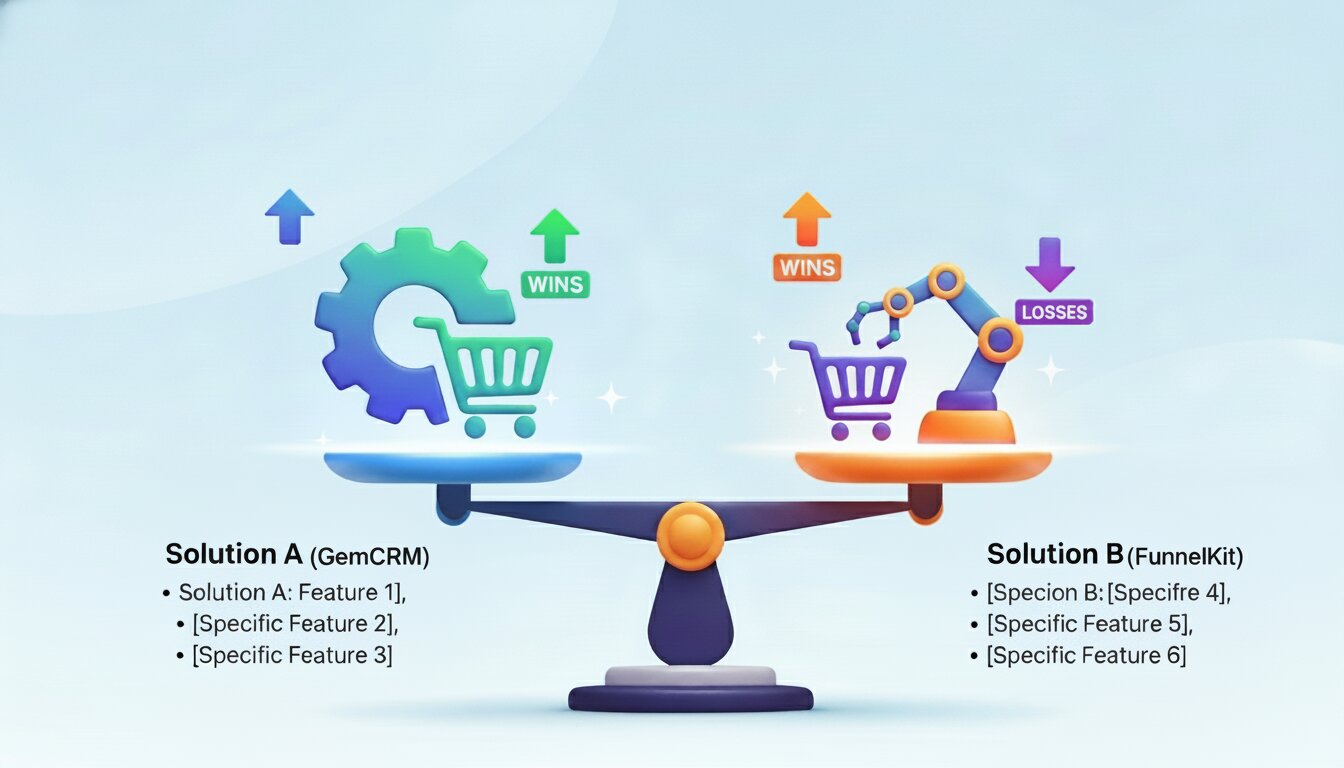
For most WooCommerce store owners, GemCRM is the smarter long-term investment. Its WordPress-native architecture, lifetime license model, unlimited contacts, and clean UX give it a structural advantage that compounds over time. With automation workflows, dynamic segmentation, and abandoned cart automation now available, GemCRM continues to expand its WooCommerce automation capabilities. The remaining differences with FunnelKit are primarily in the depth and breadth of advanced automation features.
FunnelKit remains the specialist tool for stores where abandoned cart recovery and multi-channel behavioral automation are the core business needs right now. It’s mature, powerful, and proven. But the annual subscription cost and setup complexity make it the right choice for a specific kind of store owner — not the default recommendation for everyone.
The broader trend is clear: businesses are moving toward owned, self-hosted marketing infrastructure rather than SaaS platforms where vendor pricing decisions can disrupt operations overnight. GemCRM is built precisely for this moment. If you’re evaluating WooCommerce CRM tools, start there — and graduate to FunnelKit’s complexity only when you’ve genuinely outgrown what a clean, owned CRM can deliver.
Final Thoughts
Both GemCRM and FunnelKit are serious tools — but they serve different types of store owners. GemCRM is the smarter pick if you value data ownership, flat pricing, and a clean WordPress-first experience that grows with your business without growing your monthly bill. FunnelKit wins when you need enterprise-grade automation right now and can justify the annual investment. The good news? GemCRM has already expanded its automation capabilities with automation workflows, dynamic segmentation, and abandoned cart automation, while continuing to develop the platform further.
Frequently Asked Questions (FAQ)
Is GemCRM really free forever after the lifetime purchase?
Yes. You pay once and get lifetime access with unlimited contacts, campaigns, and automation — no annual renewal required.
Can GemCRM replace FunnelKit completely?
Not completely. GemCRM now includes email campaigns, automation workflows, segmentation, and abandoned cart automation. However, FunnelKit offers a more mature feature set for advanced WooCommerce automation, including SMS and complex multi-branch workflows.
Does FunnelKit work without the funnel builder?
Yes. FunnelKit Automations (the CRM/email part) works as a standalone plugin. You don’t need the funnel builder to use automation features.
Which tool is better for beginners?
GemCRM. Its interface is simpler and designed for non-technical users. FunnelKit has a steeper learning curve and typically takes 20–30 hours to set up properly.